


Secure Enclave Signing
Field Tested

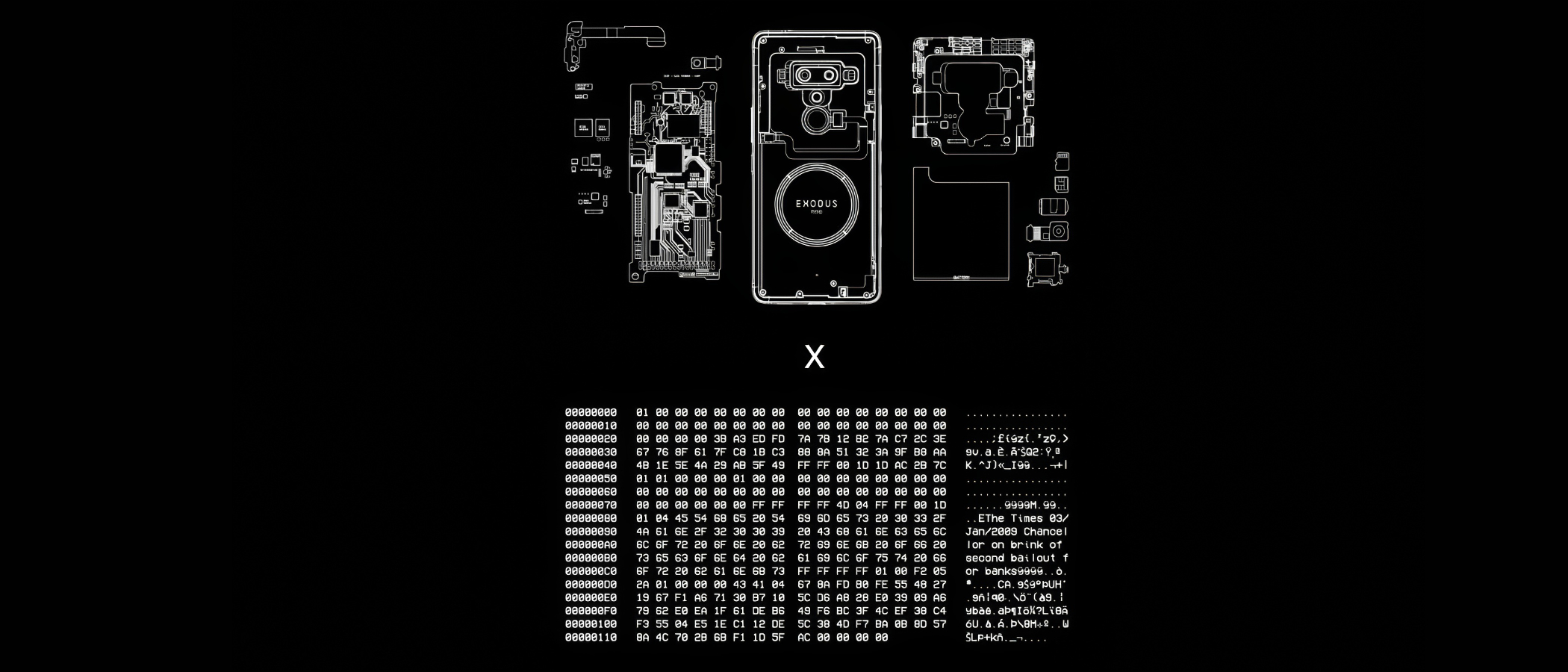
This prototype establishes a hardware-based root of trust for digital media by cryptographically sealing assets inside a device’s protected silicon environment. It shifts the security boundary from vulnerable software to dedicated cryptographic processors, ensuring that signing keys remain inaccessible to external threats and that every asset is tied to an immutable hardware identity.
By anchoring provenance at the absolute point of capture, it creates a foundational “proof of origin” that is resilient against both digital manipulation and systemic distrust.
YEAR
2022
PARTNERS
HTC
Numbers and the Numbers Protocol
LINKS
– HTX Exodus 1S Phone
– The Starling Framework
The Problem
The ideal environment to manage digital signing is a cryptographic processor within the capture device, where the keys are never revealed and the system will only sign data within a predefined pathway. This ensures all authenticated data carrying a signature by those keys are unambiguously originating from the capture device. Unfortunately, hardware secure enclaves and similar technology, are not widely included in professional capture devices, or implemented with sufficient firmware that supports these digital signing use cases.
JOURNALISM
Anchors in hardware rather than software support shielding reporters from deepfakes accusations, and gives them a digital “negative” as an origin record of their work.
HISTORY
By binding historical records to the unique physical identity of the capture device, it creates a resilient, verifiable archive that ensures the “first draft of history” cannot be silently altered by future actors.
LAW
Hardware-level signing establishes an airtight digital chain of custody and ensures cryptographic keys are physically isolated and never exposed, aiming to meet the most rigorous standards for legal admissibility.
The Solution
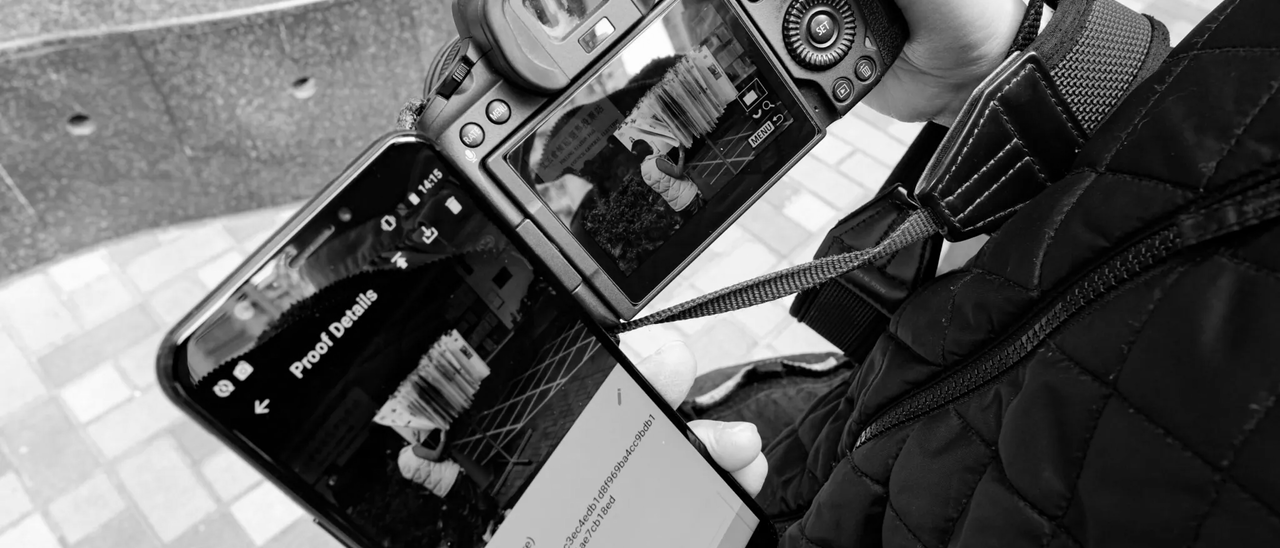
Starling Lab’s prototype utilizes Secure Enclaves (isolated cryptographic processors) to generate and store signing keys where they can never be revealed. This implementation creates a tethered workflow, pairing a digital camera with a secure-element-equipped device (such as the HTC Exodus 1S).
As media is captured, the system generates a cryptographic hash that is signed within the hardware’s protected environment, creating a tamper-evident record from the first millisecond of the asset’s existence.
This prototype serves as a technical blueprint for hardware vendors, advocating for a decentralized framework where privacy-respecting key management and data authentication are baked into the physical design of professional tools.


Timestamp Verification
Field Tested

We utilize distributed ledgers to establish an immutable “proof of existence” for digital media and its metadata. By anchoring cryptographic fingerprints on public consensus networks, it creates a tamper-evident record of the absolute moment an asset was first observed.
This “birth certificate” for digital data shifts the verification model from reactive detection to affirmative proof, ensuring that the origin and integrity of critical information remain indisputable against the threats of revisionism and synthetic manipulation.
YEAR
2020-24
PARTNERS
Hedera
ProvenDB
OpenTimestamps
Numbers Protocol
Solana
LINKS
– Time for Trusted Timestamping
– Reuters collaboration, ProvenDB anchored on Hedera
– ‘Mom I See War’, a collection of drawings from Ukrainian children, anchored on the NEAR blockchain using the Numbers Protocol.
The Problem
Establishing the originality of a piece of content, and that a given piece of media is the first known version has been a conundrum since the invention of written communication. Whether one is looking to resolve disputes of which version comes first, or to prove media was created before the advent of certain AI technologies, a timestamp that can be verified with a trustworthy third-party can be a helpful solution. Verifiable timestamping can be used as a part of the digital media creation, preservation, and edit processes.
JOURNALISM
By anchoring field footage hashes on public ledgers, newsrooms can maintain an indisputable record of truth that survives both link rot and malicious denialism.
HISTORY
By registering high-fidelity fingerprints of historic records before the generative AI inflection point, institutions ensure that primary sources can be definitively distinguished from synthetic noise.
LAW
Third-party ledgers act as record holders from which to derive strong claims about integrity and point of origin of a digital item.
The Solution
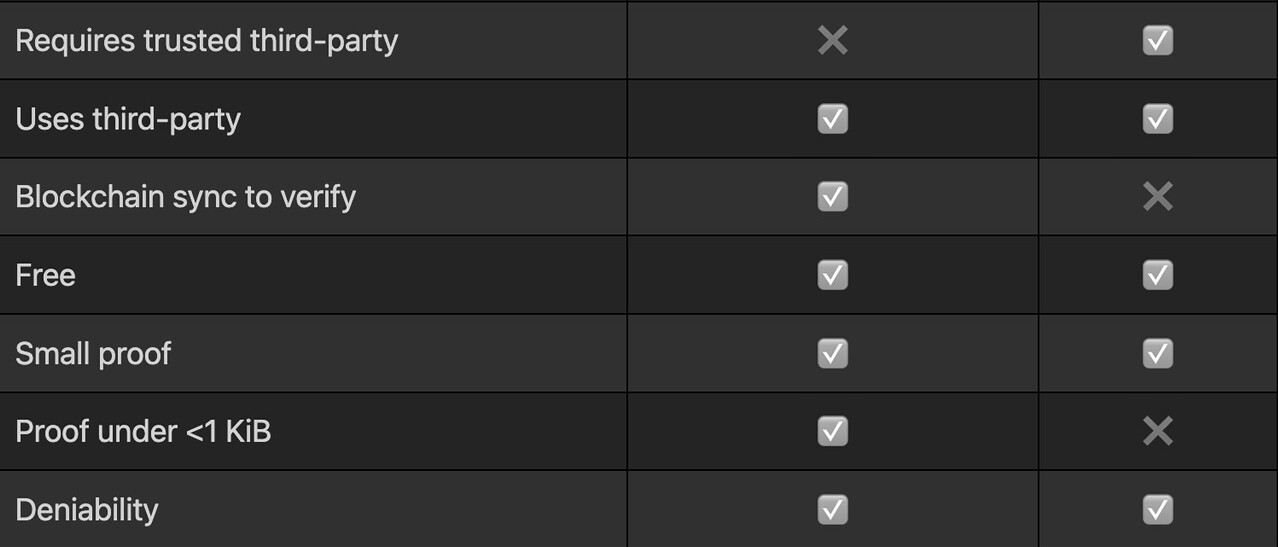
Starling has used several Merkle tree-based technologies to efficiently create verifiable timestamps on public ledgers, and developed workflow using systems such as ProvenDB with Hedera Consensus Service anchors, OpenTimestamps proofs anchored on Bitcoin, as well as direct registration of media assets on many public blockchains. In all these cases, the block height is used to establish a verifiable timestamp for the registered digital media.
Adding an immutable proof of existence backed by distributed ledger consensus serves to establish a first known creation of digital media that is nearly impossible to refute.
READ FURTHER
Further to this work, we have created a reference implementation of timestamped databases in a project called ‘Authenticated Attributes’ that aims to integrate with digital media user interfaces and collaboration tools.
We have also created an offline, SMS-based silent registration prototype based on 5G technology, and integrating with the latest C2PA-capable cameras.

Four Corners Wordpress Plugin
Field Tested
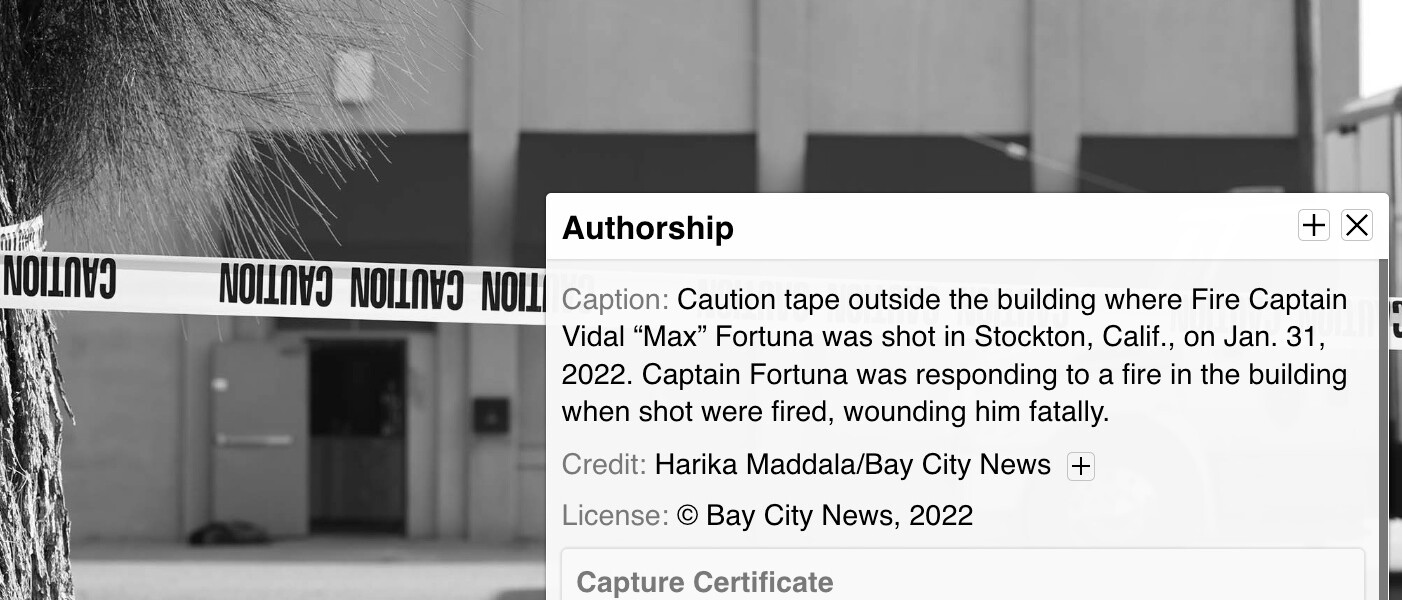
An embeddable display for photographs to show contextual and provenance information, such as photographer information, related images, and proof of existence on distributed ledgers.
YEAR
2022
PARTNERS
– Fred Ritchin
– The Four Corners Project
The Problem
Online platforms routinely strip metadata from images to protect user privacy – a necessary safeguard on the Web. However, this decontextualizes professional photojournalism, leaving viewers unable to verify a photo’s origin, time, or location. This creates a critical dilemma for photographers. They need a secure method to re-associate their work with this essential data, but require absolute control to do so.
They must be able to present this enriched, verifiable context only when they deem it safe, on platforms they trust – like their own website or a specific publication – to restore the full story behind the shot.
CASE STUDIES
– Setting the Record Straight in Brazil’s Burning Wetlands (with Inside Climate News)
– Documenting Stockton’s Homelessness (with Bay City News)
The Solution
As often with Starling’s prototypes, the process begins at the moment of capture, where technical metadata like time and location are cryptographically signed, creating a tamper-evident record of rich, contextualizing metadata. This authenticated foundation still allows a photographer to later add richer contextual information – such as their byline, a narrative description, or related images.
Based on the Four Corners Project research and user interface, Starling Lab and Four Corners co-developed a WordPress plugin to bring this UI to the biggest blogging platform on the Web. This tool allows publishers to easily embed photos with an interactive layer, enabling viewers to explore the rich, attributable context and verify the circumstances of the photo’s origin.
As part of this work, Starling worked with the Four Corners team to develop a C2PA-compliant metadata schema for bundling rich contextual metadata in C2PA manifests. This schema contained all the metadata contained in each of the Four Corners toggles. This data is then included in a C2PA manifest, and parsed by the WordPress plugin, for presenting contextual and provenance information on each article.
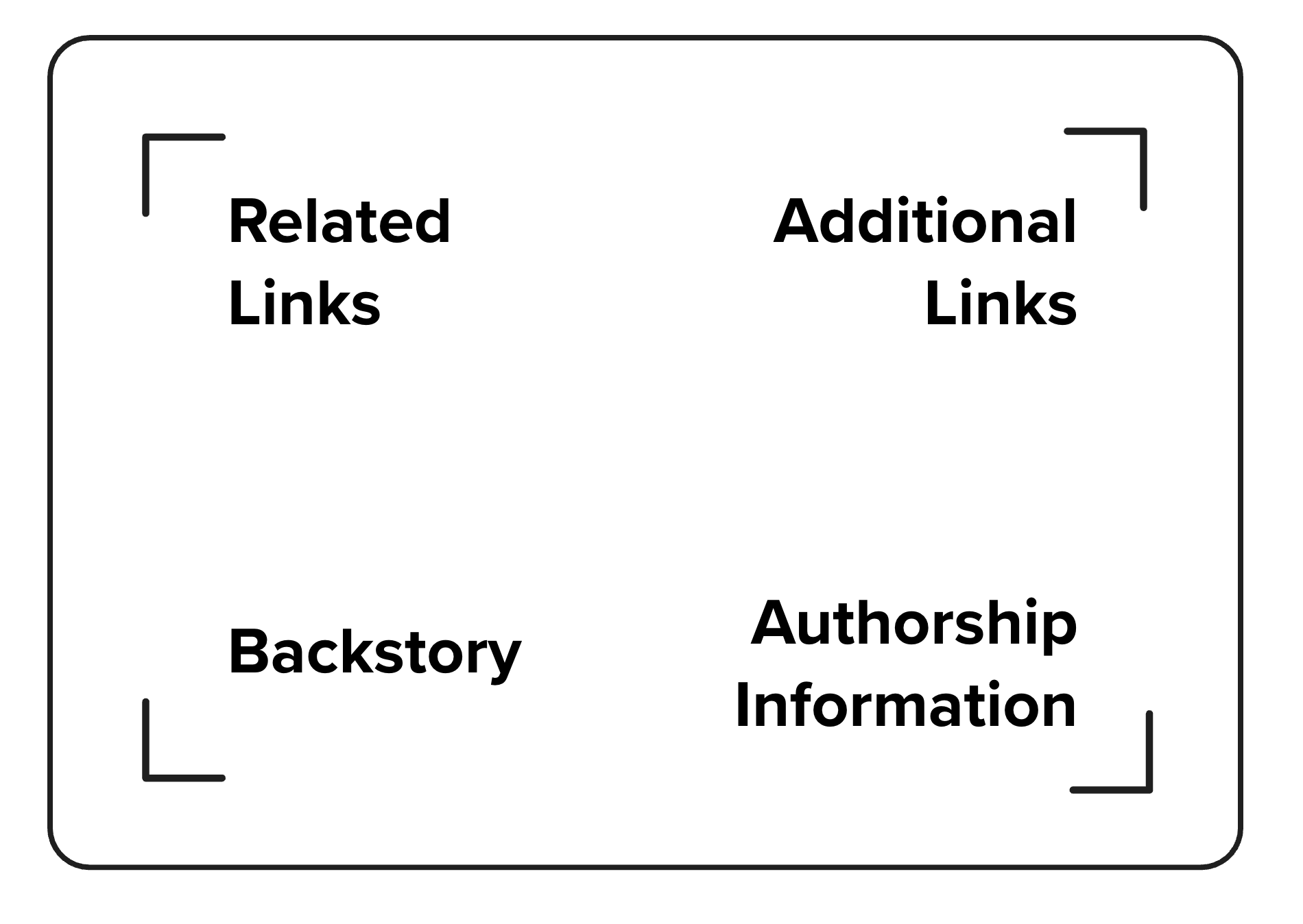
Overlaid on the photograph in each of the four corners are floating carets which, once clicked or hovered over, reveal additional data about the photograph.

Authenticated Change Tracking
Field Tested
We integrate cryptographic provenance into the newsroom’s editorial lifecycle, ensuring that every modification – from photo edits to caption and metadata updates – is recorded in a verifiable, append-only log. By retrofitting existing Content Management Systems (CMS) with an authentication layer, newsrooms can provide an unalterable “audit trail” of their reporting process.
This shifts the trust model from static files to a dynamic, tamper-evident lineage, restoring transparency to the news-gathering and publishing workflow.
YEAR
2022-25
PARTNERS
Reuters
Hypha Coop
Fotoware
LINKS
– Case study: End-to-end authentication at Reuters from Canon cameras
– On displaying this metadata with Four Corners and Wordpress
The Problem
Modern newsroom Content Management Systems (CMS) are designed for efficiency, and can be improved to provide more evidentiary rigor. While they track changes internally, these records are stored in private, centralized databases that are vulnerable to tampering and opaque to the public. As stories evolve from raw field captures to published articles, critical metadata (like original capture time or source identity) is often lost or stripped during the editing process.
This creates a “black box” that prevents audiences from verifying the reporting’s journey and leaves journalists unable to defend their work against claims of post-capture manipulation.
The Solution
Starling is working to understand the existing tools that newsrooms use to ingest information and to write and edit their stories, and we are working to integrate the ability to better track and authenticate changelogs of images, text, and other documents. Our goal is to improve the ability of newsrooms to work on authenticated information, and add authentication to changes they make, within their existing content management systems.
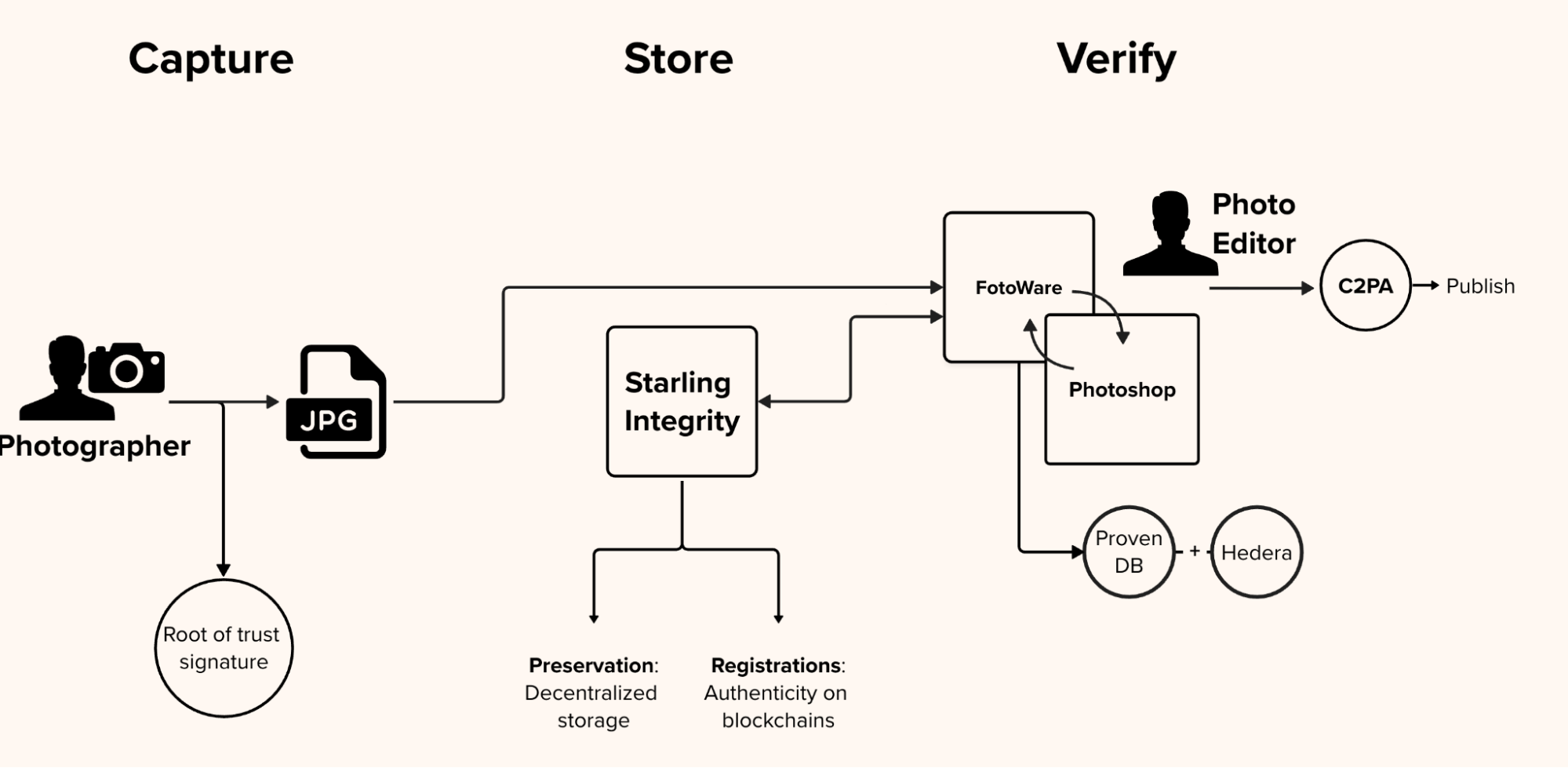
In the diagram above, CMS and Photoshop work in tandem so that the photographs’ edit history in Photoshop be reflected inside the CMS. In our milestone collaboration with Canon Camera and Reuters News, we designed a system that creates an immutable audit trail that works invisibly alongside standard newsroom tools. As the image is transmitted to the publisher’s asset management system and undergoes permissible edits by photo editors—such as cropping, color correction, or captioning—an automated background process tracks the file. Every single modification is recorded in a private, verifiable database that is anchored to a public distributed ledger, creating a mathematically provable edit log.
We are also prototyping how this information can be displayed to audiences, and looking for a greater understanding of what these metadata markers might mean to readers and the trust they place in stories and media. This final step focuses on empowering the end consumer: the reader. The prototype packages the initial hardware signature, the original metadata, and the complete, cryptographically secure edit history into a standardized, open-source manifest. This manifest is embedded directly into the final published image, allowing anyone—from researchers to everyday readers—to inspect the file and independently verify its authentic journey from the frontlines to their screen.

Document Redaction
Field Tested
Establishing a cryptographic seal of transparency for sensitive digital records, moving beyond traditional “black-box” redaction.
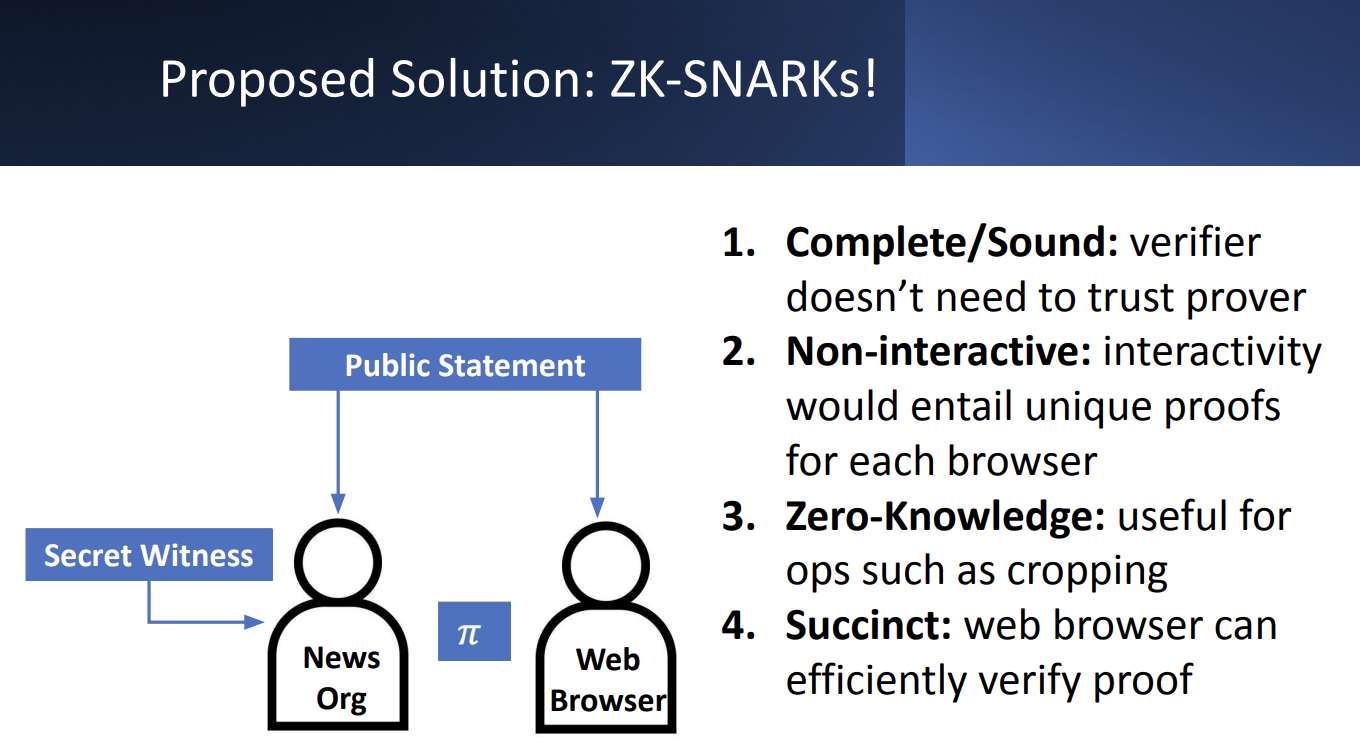
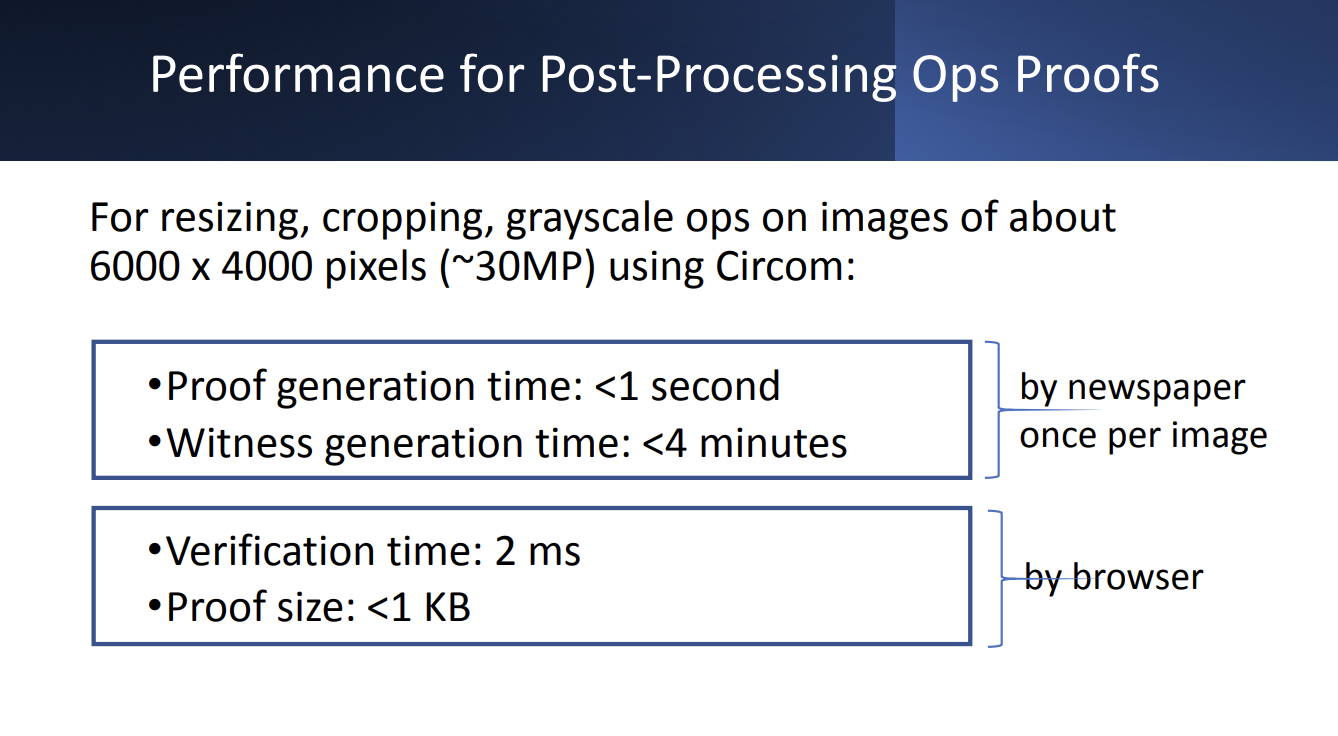
Zero-Knowledge Proofs (ZKP) allow investigators to obscure personally identifiable information (PII) while providing a mathematical guarantee that no other part of the document has been altered.
This concept shifts the trust model from requiring blind faith in a publisher’s edits to providing affirmative proof of a document’s integrity, ensuring that critical primary sources remain both ethically protected and legally robust
YEAR
2022
PARTNERS
Stanford Applied Cryptography Group
LINKS
– Case Study: The DJ and the War Crimes
– Presentation from Trisha Datta and Dan Boneh
The Problem
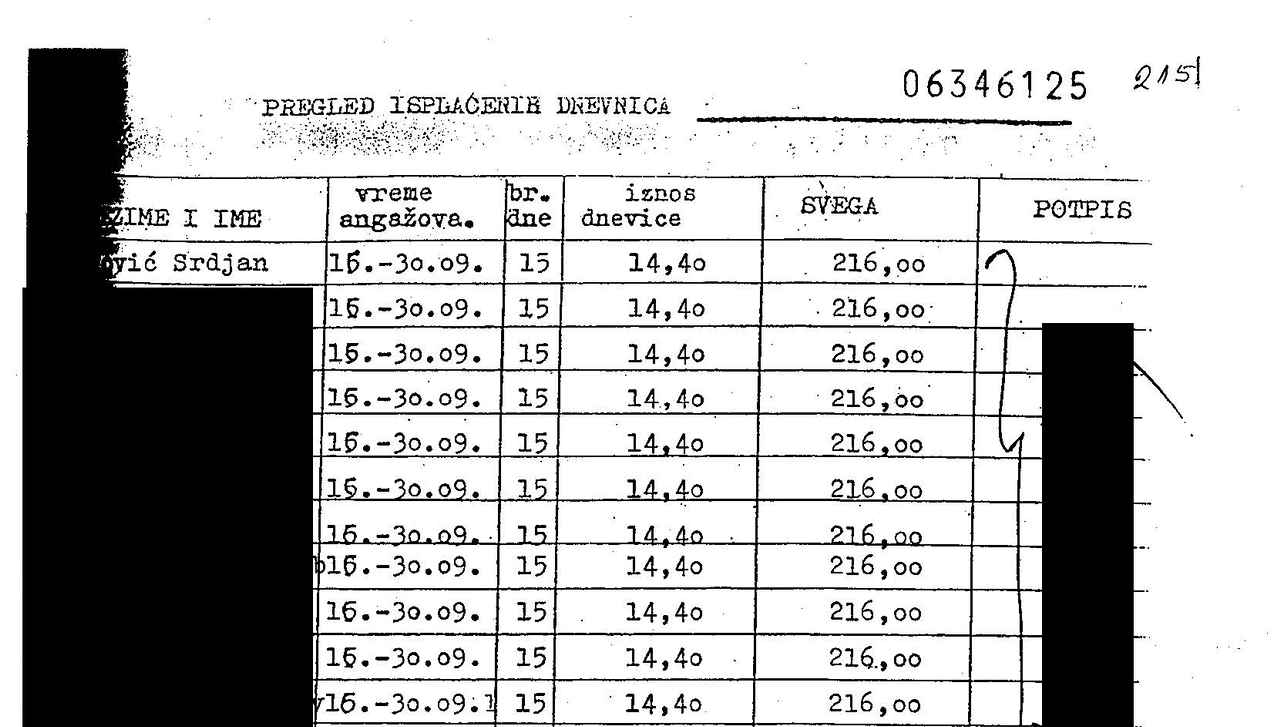
Accountability investigations often rely on digitized primary sources – such as the UN payroll records unearthed in our Bosnia war crimes probe – that contain sensitive PII of individuals not central to the investigation. While redacting this information is a journalistic and ethical necessity, it creates a “trust gap”. In an era of widespread denialism and “cheapfakes,” any manual modification to a source document can be weaponized by bad actors to claim the entire record is a forgery, undermining the evidentiary weight of critical testimonies.
The Solution
In partnership with our principal investigator’s Professor Dan Boneh’s students from the Stanford Applied Cryptography Group, Starling developed a workflow that integrates forensic ingestion with cryptographic proof systems, and managed redactions.
It relies on a Zero-Knowledge Proof that certifies the relationship between the original and the redacted file. This technology generates a mathematical proof that the only changes made to the published PDF were the addition of black boxes over specific pixels. This allows third parties, such as expert witnesses, to “check the math” and verify that no text was altered or deleted, maintaining the document’s integrity while fulfilling privacy obligations
JOURNALISM
Verifiable Redaction allows newsrooms to protect the privacy of vulnerable bystanders without sacrificing the credibility of their reporting. By providing a cryptographic guarantee that only specific PII was obscured, journalists can defend their primary sources against bad-faith accusations of manipulation.
HISTORY
This technology safeguards the sanctity of historical records by ensuring that “anonymized” archives remain verifiable links to the past.
LAW
Verifiable Redaction establishes a court-admissible chain of custody for documents containing sensitive material. ZKPs benefit can facilitate the verification of proprietary forensic software, complex discovery datasets, and sensitive testimonial claims without compromising the underlying trade secrets or personal privacy that often create insurmountable disclosure dilemmas.

Distributed Storage

Field Tested
A decentralized infrastructure designed to ensure the long-term persistence and auditability of digital records by stripping centralized platforms of their outsized control over information.
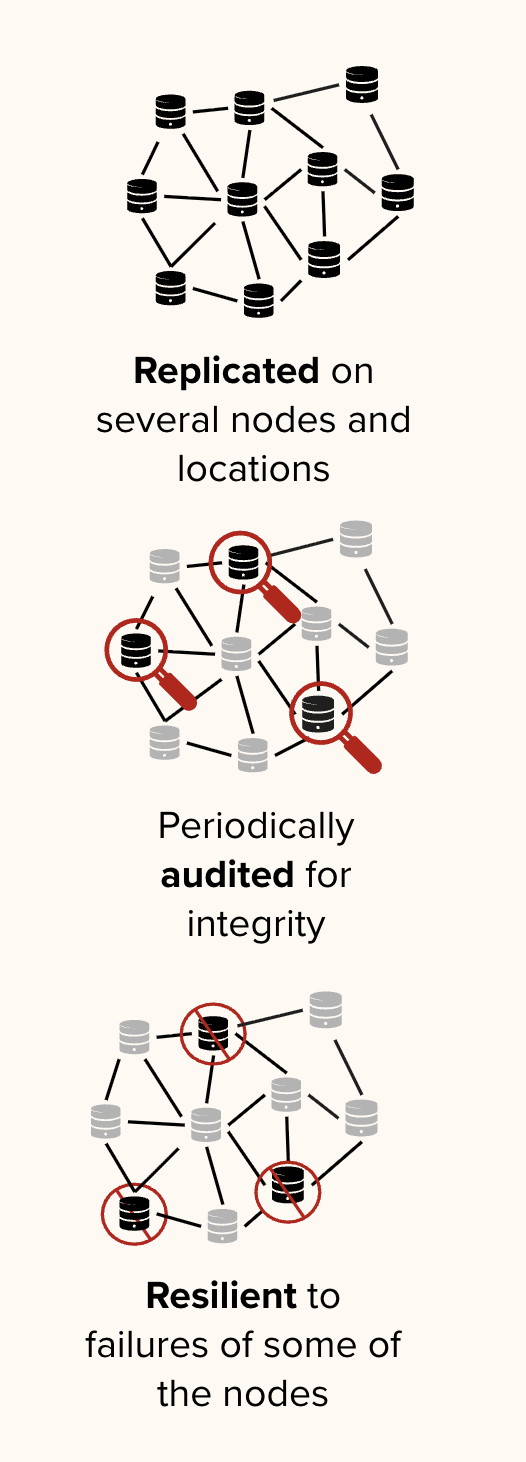
Moving beyond fragile cloud silos, it cryptographically seals media and metadata across independent, multi-jurisdictional networks .
This framework shifts the preservation paradigm from blind trust in a single provider to a “proof of existence” model, where automated audits continuously verify that data remains untampered, replicated, and accessible .
YEAR
2021-25
PARTNERS
Filecoin
IPFS
Storacha
USC Libraries
The Problem
Traditional storage models rely on centralized cloud providers and social media platforms that exercise absolute authority over the availability and integrity of digital content. This creates a single point of failure: critical historical records can be silently modified, deleted due to shifting terms of service, or lost in jurisdictional disputes.
Standard databases also lack the transparency required for “chain-of-custody” documentation, making it difficult for archivists to prove that a file has not been altered since its initial preservation .
LINKS
– Case Study: Preserving 70 Years of Testimony with the USC Shoah Foundation
– Preserving Armenian Cultural Heritage on the Decentralized Web
– “Mom, I See War”, a collection of drawings from Ukrainian children, preserved on decentralised storage
The Solution
Starling Lab leads the world’s first academic center dedicated to using decentralized tools to advance human rights, backed by a multi-million dollar commitment from Protocol Labs and the Filecoin Foundation. We have moved beyond theoretical prototypes to large-scale implementations that safeguard humanity’s most sensitive digital records.
Our collaboration with the USC Shoah Foundation permanently preserves an archive of 55,000 video testimonies from genocide survivors. In tandem with the USC Digital Repository, a service of the USC Libraries, we run a 22-petabyte Filecoin node at USC – just one part of the Libraries’ deep expertise in preservation and archiving.
By housing this node within a leading research university, we combine the innovation of Web3 protocols with the rigorous preservation standards developed over decades by archivists and librarians.

Authenticated Camera Capture
Field Tested
Authenticated Camera Capture establishes a root of trust at the absolute moment of creation by embedding cryptographically signed metadata directly into media files. Spearheaded by the C2PA standard and major manufacturers like Leica, Sony, and Nikon, these prototypes shift the verification paradigm from reactive deepfake detection to affirmative proof of origin.
They rely on hardware-backed secure enclaves to sign images with private keys, ensuring that every photo or video carries a tamper-evident record – a “birth certificate” – that traces back to the original sensor and time of capture.
YEAR
2020-26
PARTNERS
Canon Cameras
Reuters
Adobe (Content Authenticity Initiative)
Leica Cameras
The Problem
Photographs circulate globally, often years after capture, stripped of metadata and decontextualized. Viewers are left unsure of who captured an image, or when and where events occurred. This vulnerability is exploited by bad actors using AI to manipulate content, giving rise to the “Liar’s Dividend” where even authentic evidence can be dismissed as a deepfake.
Furthermore, existing “companion device” workflows (pairing a camera to a smartphone) often suffer from field challenges like Wi-Fi connection issues, battery drain, and the technical complexity of managing multiple devices in high-pressure conflict zones.
Finally, a core challenge in authenticating news media is accounting for the reality of permissible edits. In photojournalism, editing a raw file is not inherently deceptive; it is a necessary step in the editorial process. Photo editors routinely crop images to fit specific publication layouts, adjust exposure or color balance to ensure visual clarity, and append critical contextual metadata such as captions, location data, and copyright credits. While these routine, ethical adjustments do not alter the factual truth of the scene, they inherently change the digital fingerprint of the file.
CASE STUDIES
– Canon-Reuters Collaboration on Preserving Trust in Photojournalism
LINKS
– The Canon-Reuters prototype POC
– Petapixel: Canon and Reuters develop new photo authentication technology
– On offline benefits: our submission to the UN Special Rapporteur on Human Rights Defenders
The Solution
We experimented with several authenticated camera-centric workflows that enabled professional cameras to natively generate and sign C2PA manifests upon capture. By integrating signing keys into hardware-based secure enclaves (Trusted Platform Modules), the system ensures that private keys cannot be extracted or cloned, establishing a permanent “root-of-trust” within the device’s silicon.
From lens to a reader’s screen, this “glass-to-glass” chain of custody, pioneered with specialized firmware for Canon devices, injects rich, signed metadata—including server-acquired timestamps and GPS coordinates—directly into JPEG files. This ensures that every asset carries its own proof of integrity, allowing audiences to audit the steps taken from the initial shutter click to publication through standard inspection tools.
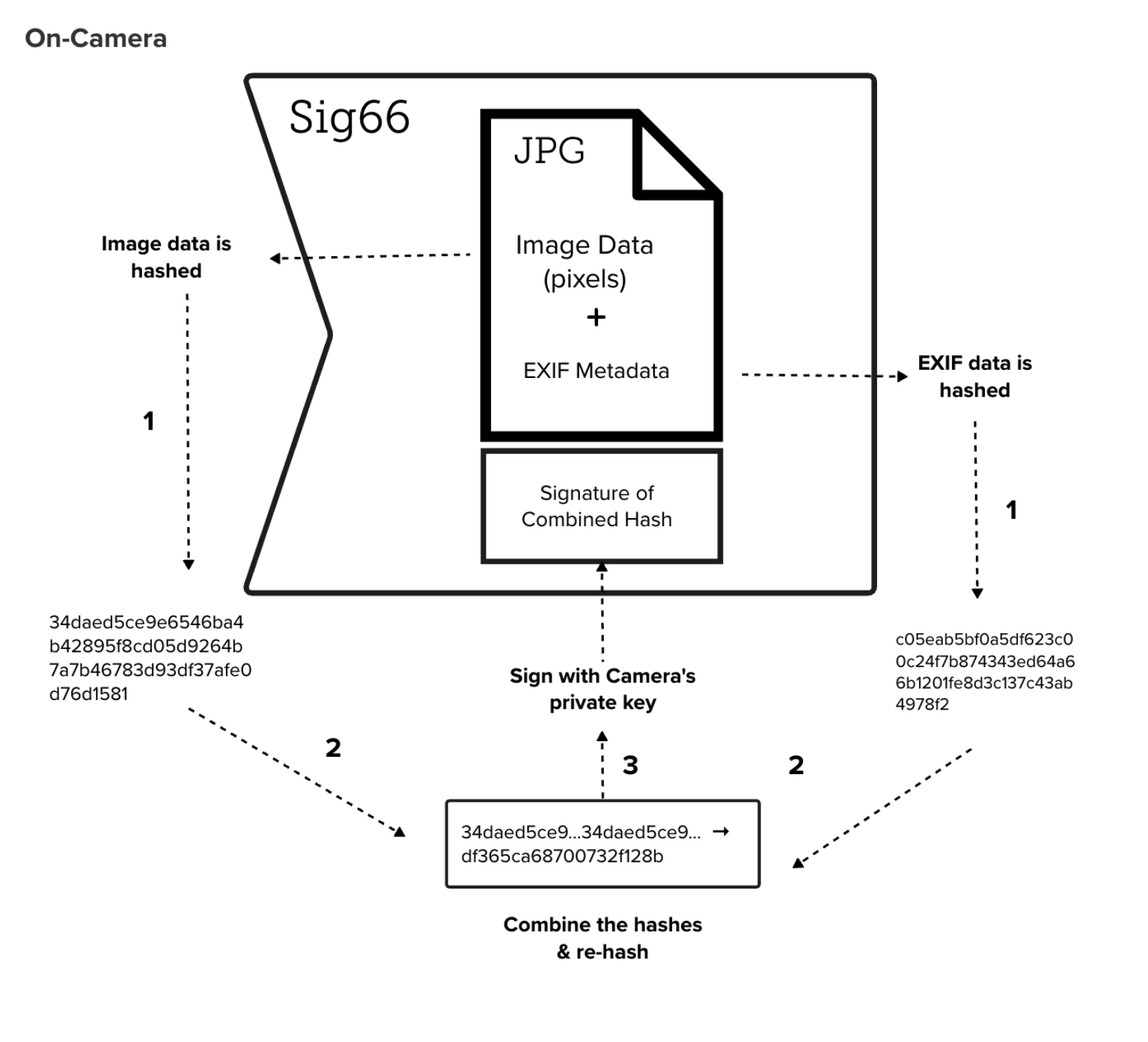
The on-camera process. The firmware computes a combination hash of image pixels and EXIF metadata, signs it with a unique factory-programmed private key, and appends the signature to the JPEG data.
To bridge the gap between capture and publication, the Starling Integrity backend tracks permissible modifications in the background. Using webhooks within the Fotoware CMS, every edit, from caption updates to Photoshop adjustments, is recorded as a new entry in a C2PA manifest and anchored to the Hedera public ledger. This creates a mathematically provable, immutable audit trail that survives the industrial scale processing of a global newsroom.

ProofMode Authentication
Field Tested
Experimenting with the integration of lightweight, forensic-grade verification into secure messaging workflows.
YEAR
2022-23
PARTNERS
Guardian Project
Hala Systems
Signal Messenger
LINKS
– Case Study: The Proof’s in your Pocket
– From the Guardian Project team: Integrating libProofMode
The Problem
Citizen-captured photos and videos are becoming powerful reporting tools. But faked footage, or footage with missing crucial context, threatens to break the trust between a newsroom and its audience. Professional journalists thus need to be able to vet the footage captured by citizens to ensure that the files sent in by citizen journalists are authentic and accurate representations of the depicted event.
The Solution
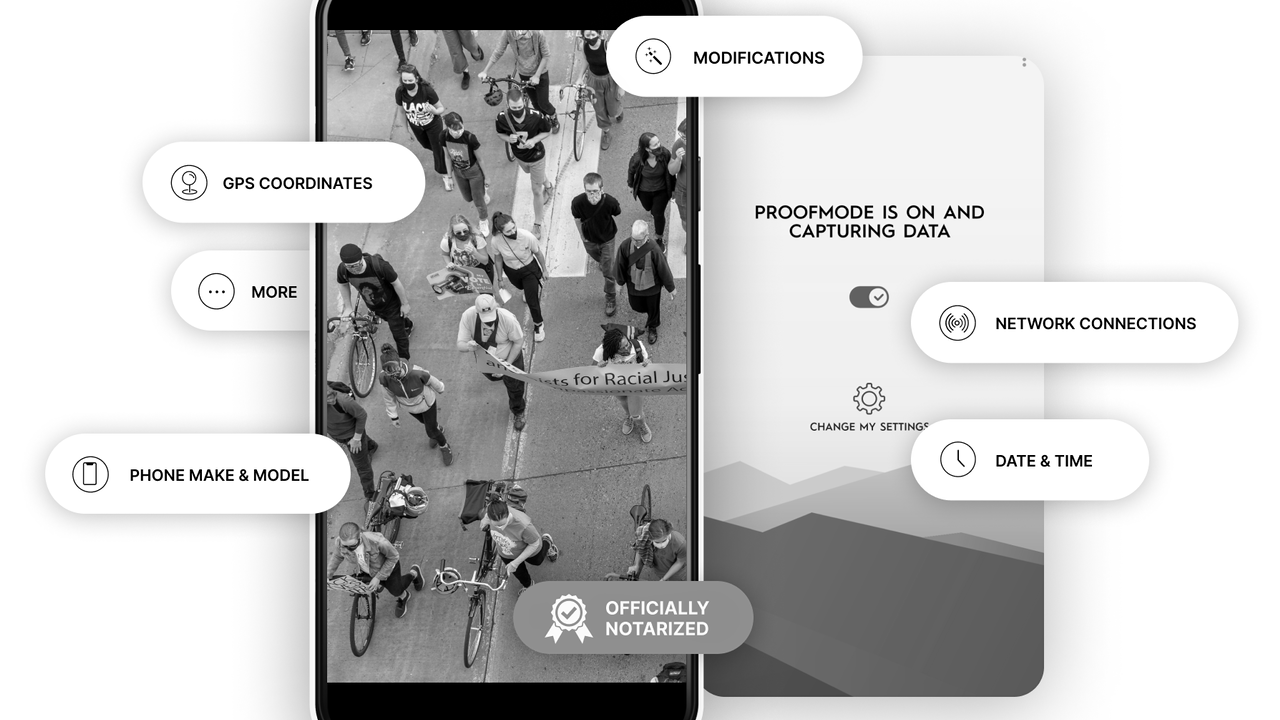
ProofMode (developed by the Guardian Project) promotes trust by providing a means to strongly authenticate multimedia at the point of capture.
We were the first to experiment with its distribution as a software library, under the name libProofMode. Starling Lab developed a bespoke fork of Signal Messenger that embeds authentication as a native feature. Users of this custom app can snap photographs directly within the app, which automatically generates a unique OpenPGP key pair to sign the media and its surrounding sensor metadata, including location, time, and cell tower environment.
At capture, media hashes are automatically registered on OpenTimestamps to create a “proof of existence” on the Bitcoin ledger. To ensure secure transport, every file sent via Signal triggers an automated MobileCoin micro-transaction; the first 16 digits of the “proof hash” are embedded in the transaction memo, allowing the recipient to cryptographically verify that the file received exactly matches the file captured in the field.
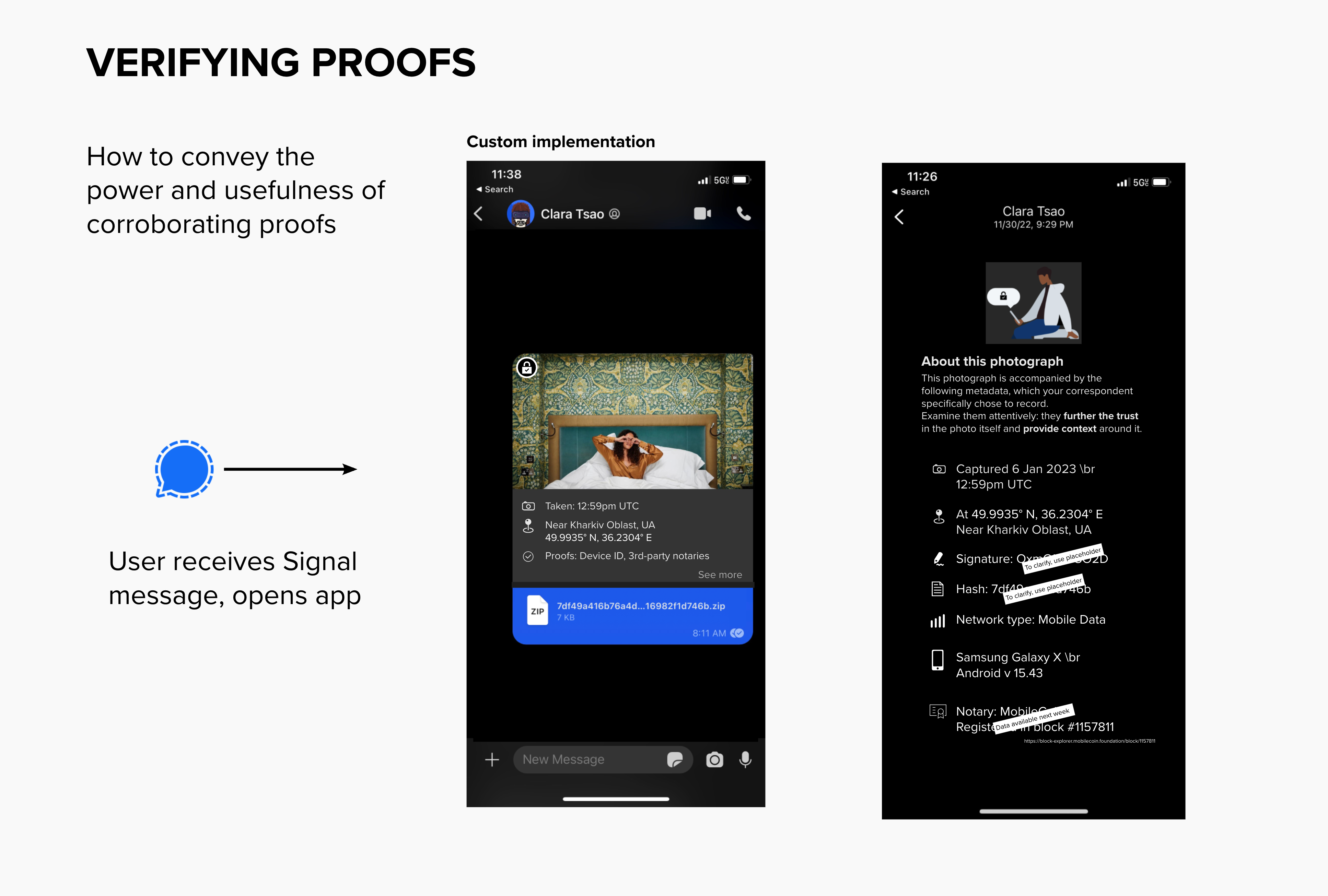
To reduce the burden on legal and journalistic investigators, the prototype features a visual layer of UI inside the Signal conversation view. Both sender and recipient can instantly surface contextual metadata snapshots and check them against immutable third-party record holders, such as the LikeCoin or Avalanche blockchains. This “glass-to-glass” approach ensures that technical authenticity markers are accessible and legible to the field practitioners who need them most.
HIGHLIGHT
In response to the shelling of Kharkiv’s schools, Starling Lab launched Project Dokaz (“Proof”). Local photographers were equipped with the custom Signal app to conduct “preventative documentation” in support of the Safe Schools Declaration. By capturing regular rounds of authenticated imagery, the team was able to verify the absence of military co-option at these sites, confirming their protected status under international law.
Read mode about Project Dokaz →

Companion Secure Enclave Authentication
Field Tested
Companion Secure Enclave Authentication provides a “secure bridge” for professional photojournalism by tethering standalone cameras to mobile devices with hardware-level security. By pairing a professional camera with a smartphone’s secure enclave (such as the HTC Zion Vault), this prototype establishes a root-of-trust for images that traditional cameras cannot natively sign.
This method ensures that every photo is cryptographically sealed with a unique digital signature and sensor-rich metadata at the exact location and time of capture, creating an unalterable record of reality.
YEAR
2020-24
PARTNERS
HTC
Inside Climate News
Bay City News
Numbers
The Problem
Most professional cameras used in the field lack the internal hardware necessary to cryptographically sign assets or protect signing keys. Without a tamper-evident seal, digital photographs and their metadata (such as GPS and timestamps) are vulnerable to manipulation by AI tools or bad actors.
As these unverified images circulate, they lose their essential context, making it nearly impossible to determine the original version or defend against cheap- or deepfake allegations that distort the facts reported by photojournalists.
The Solution
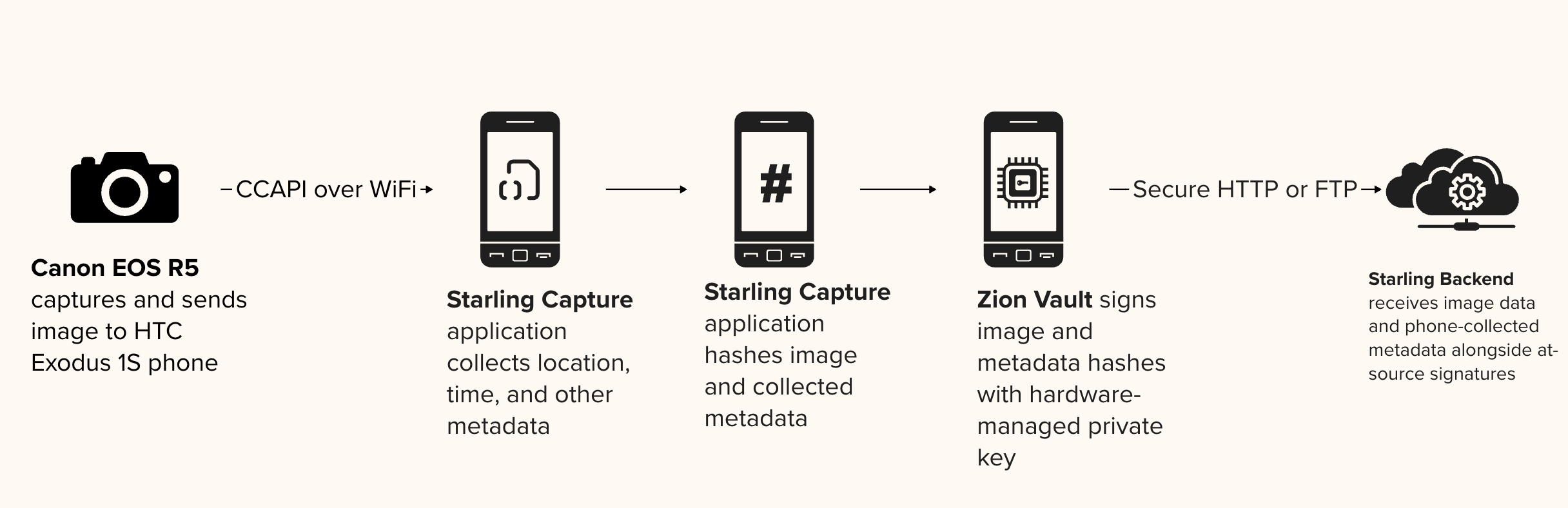
Starling Lab pioneered a workflow that utilizes the hardware secure enclave of a companion smartphone to sign media from high-end cameras.
By tethering a professional camera (such as a Canon R5) to an HTC Exodus 1S phone via WiFi or USB, the Starling Capture app (co-developed with Numbers) instantly receives captured media. The phone’s Zion Vault hardware-secured signer then generates a cryptographic hash of the image and its associated sensor data (barometer, gyroscope, and GPS), sealing it with a private key that never leaves the device’s protected silicon.
CASE STUDIES
Stockton Homelessness: In 2022, Bay City News photojournalists documented the homelessness crisis in Stockton, CA, using Canon R5 cameras paired with HTC devices. These “authenticated time capsules” provided a verifiable record that challenged official statements and misinformation surrounding local funding disparities.
Brazil Pantanal: Photographer Felipe Albarenga documented the 2020 wildfires in the world’s largest wetland. By using the companion secure enclave, Albarenga created a tamper-evident archive of the devastation that could withstand the propaganda and denialism prevalent during the Brazilian presidential election.

Authenticated Web Archives
Field Tested
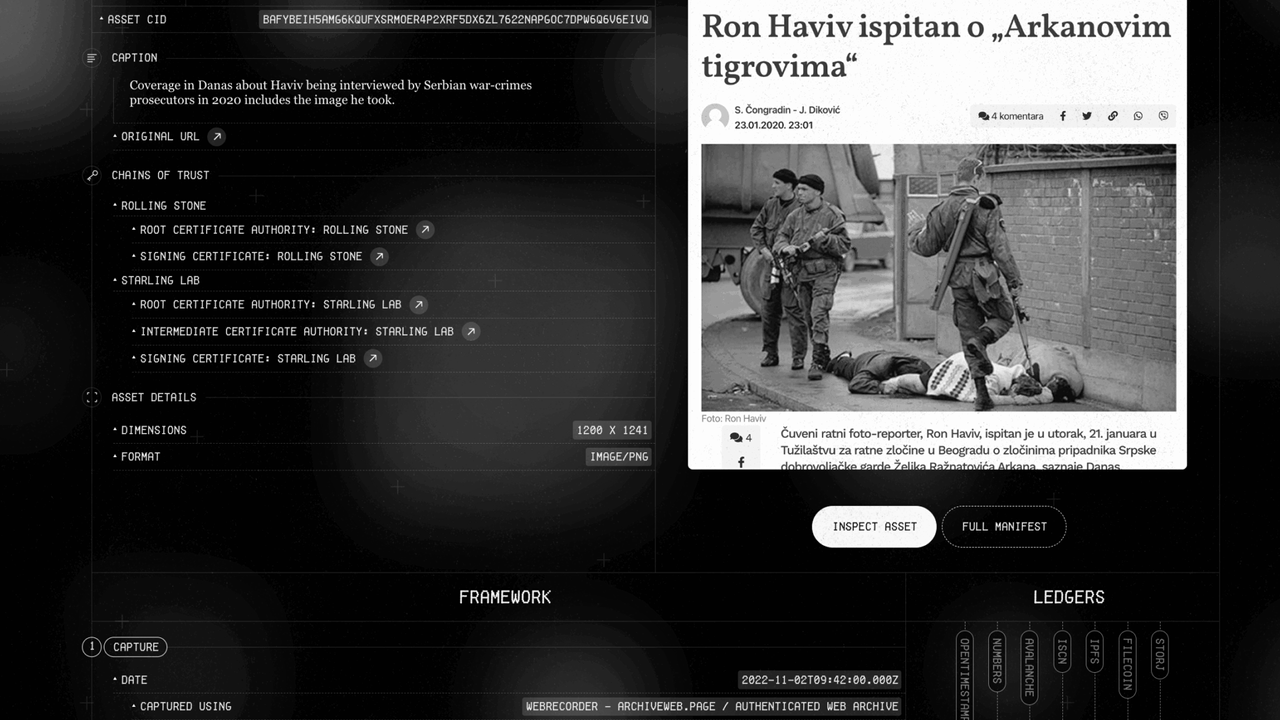
Accurate, reliable, simple to use, and secure workflows for archiving web content.
The Problem
Online content disappears rapidly, erasing critical evidence for investigative journalism, accountability, and cultural preservation. Social media platforms and hosting providers face pressure to implement stricter content moderation, with automated filters and human moderators making rapid decisions about what stays online. Records documenting potential crimes – especially those with violent imagery – risk being permanently deleted. Restoring content is often impossible: original posters may be arrested, lose device access, or no longer be alive when investigations begin.
Existing archiving methods face three challenges: platforms actively block automated crawlers, preserved content lacks the cryptographic verification and chain-of-custody documentation required for legal admissibility, and saved material becomes unsearchable across large collections.
JOURNALISM
Strong web archives provide a tamper-evident way to capture online evidence, safeguarding reporting against censorship and the erosion of digital sources.
HISTORY
These archives create a trustworthy and resilient collection of digital primary sources, ensuring that the ephemeral nature of the web does not erase our collective memory.
LAW
This technology establishes an unbreakable digital chain of custody, transforming fleeting web content into verifiable, court-admissible evidence.
The Solution
Starling is developing workflows using open source software for archiving web content to ensure the preserved archives are accurate and reliable, taking into consideration the sensitivity of the data. We draw from the considerable expertise deployed by national libraries and legal deposits from around the world.
Our case studies have experimented with forensically-sound web archiving, focusing on capturing broad contextual snapshots of web material.
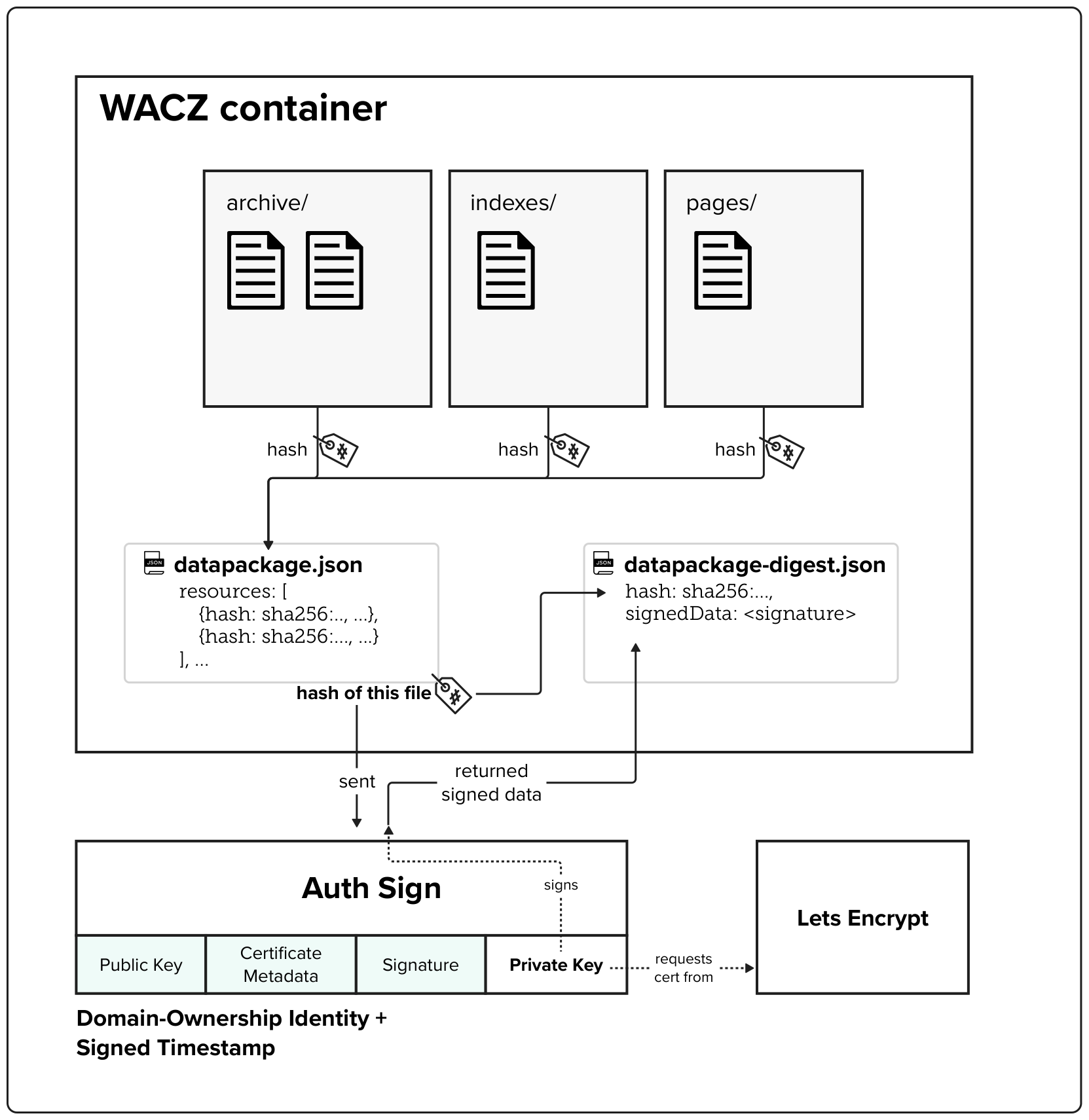
The WACZ standard and file format
The Web Archive Collection Zipped (WACZ) standard provides a portable packaging format for web archives that bundles WARC data, indexes, metadata, and verification information into a single ZIP file. Unlike traditional WARC files that lack contextual information and require complex server infrastructure for viewing, WACZ enables efficient browser-based rendering by organizing content with indexes that allow random access to only the data needed for each page.
Built-in Integrity Through Cryptographic Hashing
Every WACZ file includes a datapackage.json manifest that contains cryptographic hashes of all resources within the archive, providing a verifiable fingerprint to detect any unauthorized modifications. This hash-based integrity checking ensures that archived content remains tamper-evident throughout its lifecycle.
Authentication Through Digital Signatures
The specification adds optional authentication capabilities by allowing creators to digitally sign archives – notably using TLS certificates. These signatures validate both the identity of the entity creating the archive (using X.509 SSL certificates) and establish a trusted timestamp for when the capture occurred.