

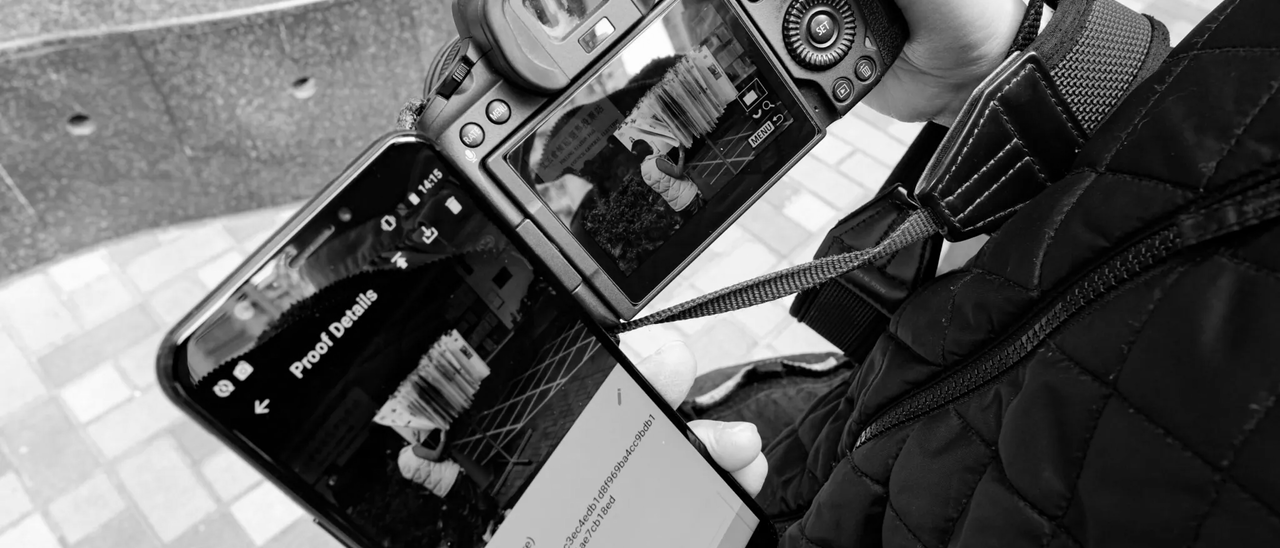
Authenticated Camera Capture

Authenticated Camera Capture establishes a root of trust at the absolute moment of creation by embedding cryptographically signed metadata directly into media files. Spearheaded by the C2PA standard and major manufacturers like Leica, Sony, and Nikon, these prototypes shift the verification paradigm from reactive deepfake detection to affirmative proof of origin.
They rely on hardware-backed secure enclaves to sign images with private keys, ensuring that every photo or video carries a tamper-evident record – a “birth certificate” – that traces back to the original sensor and time of capture.
YEAR
2020-26
PARTNERS
Canon Cameras
Reuters
Adobe (Content Authenticity Initiative)
Leica Cameras
The Problem
Photographs circulate globally, often years after capture, stripped of metadata and decontextualized. Viewers are left unsure of who captured an image, or when and where events occurred. This vulnerability is exploited by bad actors using AI to manipulate content, giving rise to the “Liar’s Dividend” where even authentic evidence can be dismissed as a deepfake.
Furthermore, existing “companion device” workflows (pairing a camera to a smartphone) often suffer from field challenges like Wi-Fi connection issues, battery drain, and the technical complexity of managing multiple devices in high-pressure conflict zones.
Finally, a core challenge in authenticating news media is accounting for the reality of permissible edits. In photojournalism, editing a raw file is not inherently deceptive; it is a necessary step in the editorial process. Photo editors routinely crop images to fit specific publication layouts, adjust exposure or color balance to ensure visual clarity, and append critical contextual metadata such as captions, location data, and copyright credits. While these routine, ethical adjustments do not alter the factual truth of the scene, they inherently change the digital fingerprint of the file.
CASE STUDIES
– Canon-Reuters Collaboration on Preserving Trust in Photojournalism
LINKS
– The Canon-Reuters prototype POC
– Petapixel: Canon and Reuters develop new photo authentication technology
– On offline benefits: our submission to the UN Special Rapporteur on Human Rights Defenders
The Solution
We experimented with several authenticated camera-centric workflows that enabled professional cameras to natively generate and sign C2PA manifests upon capture. By integrating signing keys into hardware-based secure enclaves (Trusted Platform Modules), the system ensures that private keys cannot be extracted or cloned, establishing a permanent “root-of-trust” within the device’s silicon.
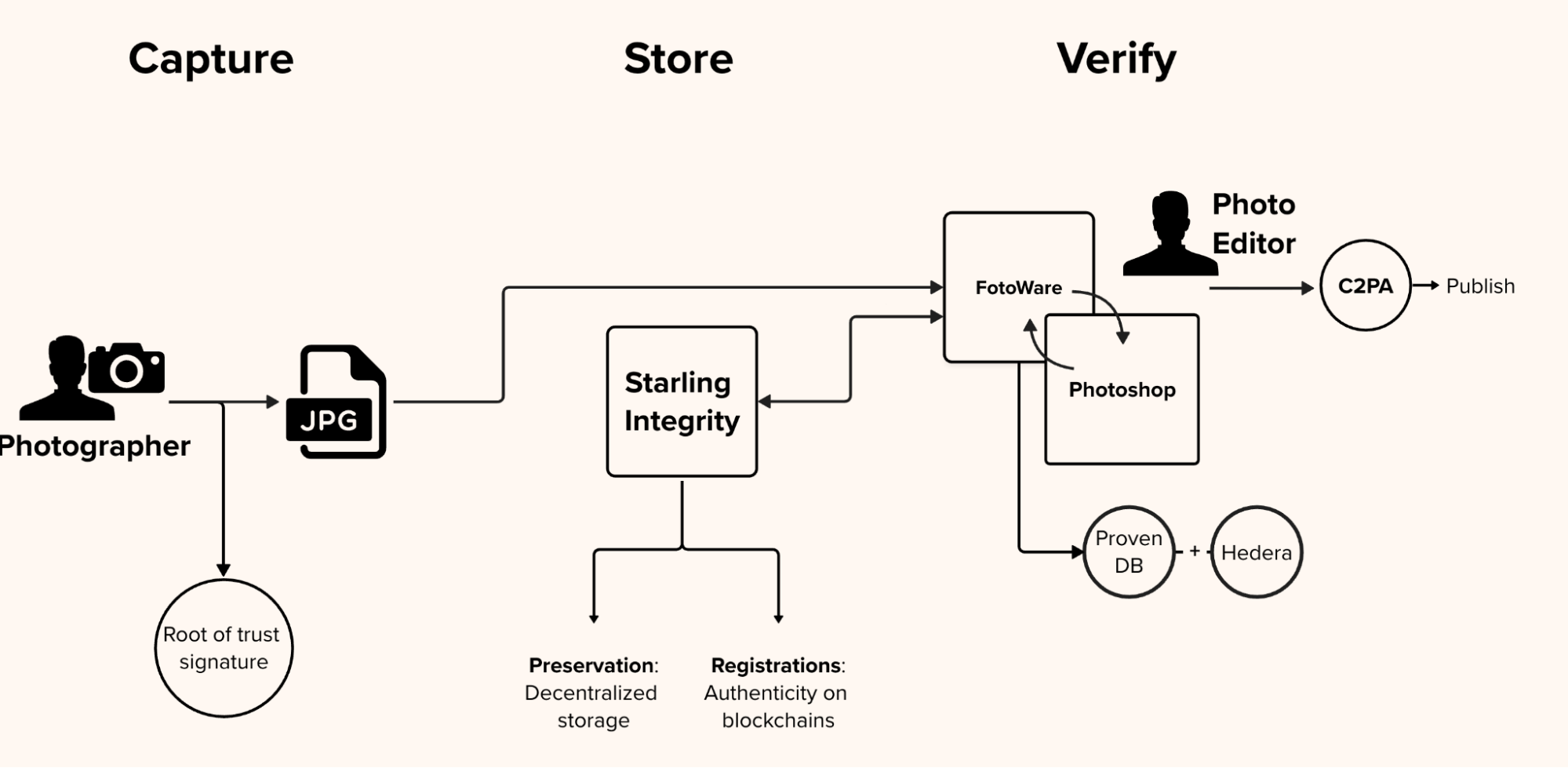
From lens to a reader’s screen, this “glass-to-glass” chain of custody, pioneered with specialized firmware for Canon devices, injects rich, signed metadata—including server-acquired timestamps and GPS coordinates—directly into JPEG files. This ensures that every asset carries its own proof of integrity, allowing audiences to audit the steps taken from the initial shutter click to publication through standard inspection tools.
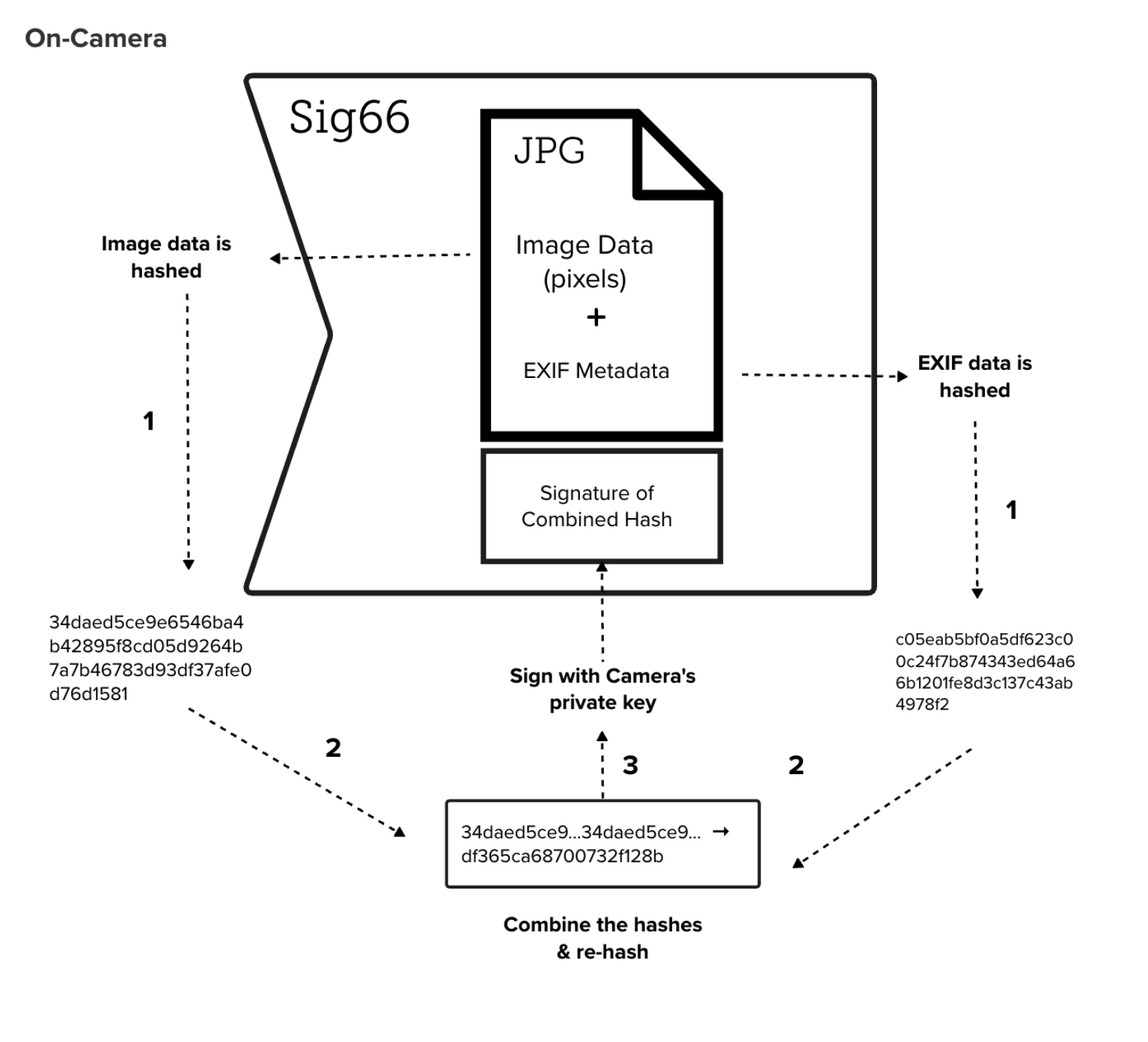
The on-camera process. The firmware computes a combination hash of image pixels and EXIF metadata, signs it with a unique factory-programmed private key, and appends the signature to the JPEG data.
To bridge the gap between capture and publication, the Starling Integrity backend tracks permissible modifications in the background. Using webhooks within the Fotoware CMS, every edit, from caption updates to Photoshop adjustments, is recorded as a new entry in a C2PA manifest and anchored to the Hedera public ledger. This creates a mathematically provable, immutable audit trail that survives the industrial scale processing of a global newsroom.