

Immutable Elections: Verifying Taiwan’s 2024 Vote

Immutable Elections: Verifying Taiwan's 2024 Vote
Read how reporters built a cryptographically verified base of evidence—combining on-the-ground photos with authenticated web archives—to secure the truth of Taiwan’s 2024 elections.
Reading Time: 5min

Contents
Background
Tensions were remarkably high during the Taiwanese presidential and legislative elections held in January 2024. The ruling-party candidate Lai Ching-te was, at the time, vice president of the Democratic Progressive Party (DPP) and had rejected claims of sovereignty by China. Facing strong opposition from Beijing, Lai ran in a high-stakes, three-way presidential race carrying dramatic geopolitical implications for the region. Mr. Lai emerged victorious, and pledged to try and open dialogue between China and Taiwan, while also safeguarding against threats and upholding Taiwanese sovereignty.
The 113-seat Taiwanese legislature was also on the ballot, and similarly high-stakes. Prior to 2024, the DPP held majority; however, the election resulted in a loss of that control, creating significant legislative hurdles for passing pro-separatist legislation.
The political status of Taiwan has long been a contentious issue. Since the mid-20th century, Taiwan has been governed independently, though Beijing views the island as a part of the ‘Republic of China’ (ROC). The Kuomintang Party (KMP) signed a consensus in 1992 that recognizes Taiwan as a part of the ROC, and does not support independence from China. The DPP does not share similar views and does not accept the consensus made by the KMT.
This election was contentious to the Chinese government, an administration that had a record of disinformation campaigns as well as a history of diplomatic pressure and intimidation tactics from the Chinese military. Taiwan has a strong economy due to its successful semiconductor and manufacturing industries and is a global economic player. Due to these circumstances, there was a high likelihood that different players could try to influence election information and coverage in their favor, and that bad actors across the globe could attempt to distort the truth.
Contents

Context
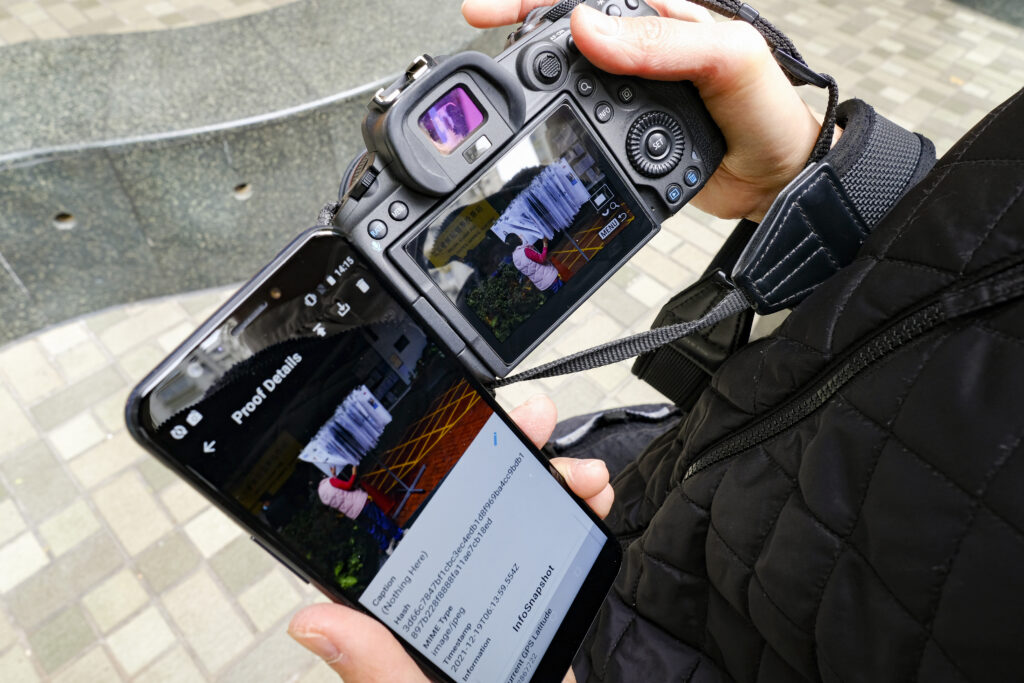
Numbers Protocol and Starling Lab have been working together since 2019 to develop applications that can capture and preserve digital media and metadata – as well as provenance information contextualizing both capture and media. We started out with a prototype application called ‘Starling Capture’ – a fork of another prototype developed by Numbers, developed and deployed in an earlier Starling Lab fellowship. That early application introduced robust hashing and signing capabilities for camera-captured digital media, coupled with blockchain registration and secure data transmission to backend servers. It successfully processed photos directly from Canon cameras via the Canon Camera API and supported hardware-level cryptographic signing using an HTC phone’s secure enclave.
Following this prototype, Numbers subsequently developed a new platform with a different architecture and a more consumer-friendly design: Numbers Capture. Designed for creators, artists, and photojournalists, Numbers Capture provides a seamless way to acquire blockchain proofs that ensure content integrity, protect copyrights, and enable the monetization of digital work.
Simultaneously, Starling Lab was prototyping Authenticated Attributes, a powerful database add-on designed to help investigative teams compile and manage information in a secure, trustworthy manner. Built atop the open-source CMS platform Uwazi, this collaborative tool—referred to as Uwazi + Authenticated Attributes—was engineered to visualize connections between digital assets. It empowers investigators to cross-reference multiple sources against a single piece of media while displaying the underlying cryptographic proofs necessary to verify the evidence’s veracity and authenticity.
The Taiwanese presidential and legislative elections were the perfect event to model both a verifiable licensing platform, and the investigative platform. In these elections, stakes were high, and the truth of what was happening on the ground was easily sullied with mis- and disinformation.
For this project, Numbers enlisted journalists from reputable Taiwanese news agencies to participate in the testing and prototyping of these platforms. Participants included the leading public service broadcaster PTS (Public Television Service), the premier international media platform TaiwanPlus, local media giant SETN, non-profit news organization The Reporter, independent photojournalists working with EyePress News Agency, and the national news agency, Central News Agency (CNA).
Four of the journalists who used the Numbers Capture platform from these agencies also participated in a test case using the Uwazi + Authenticated Attributes platform, uploading digital media, metadata, participated in a demo of the platform, then completed tasks and a user survey to learn and give feedback about the platform.
Contents
Framework
The Challenge
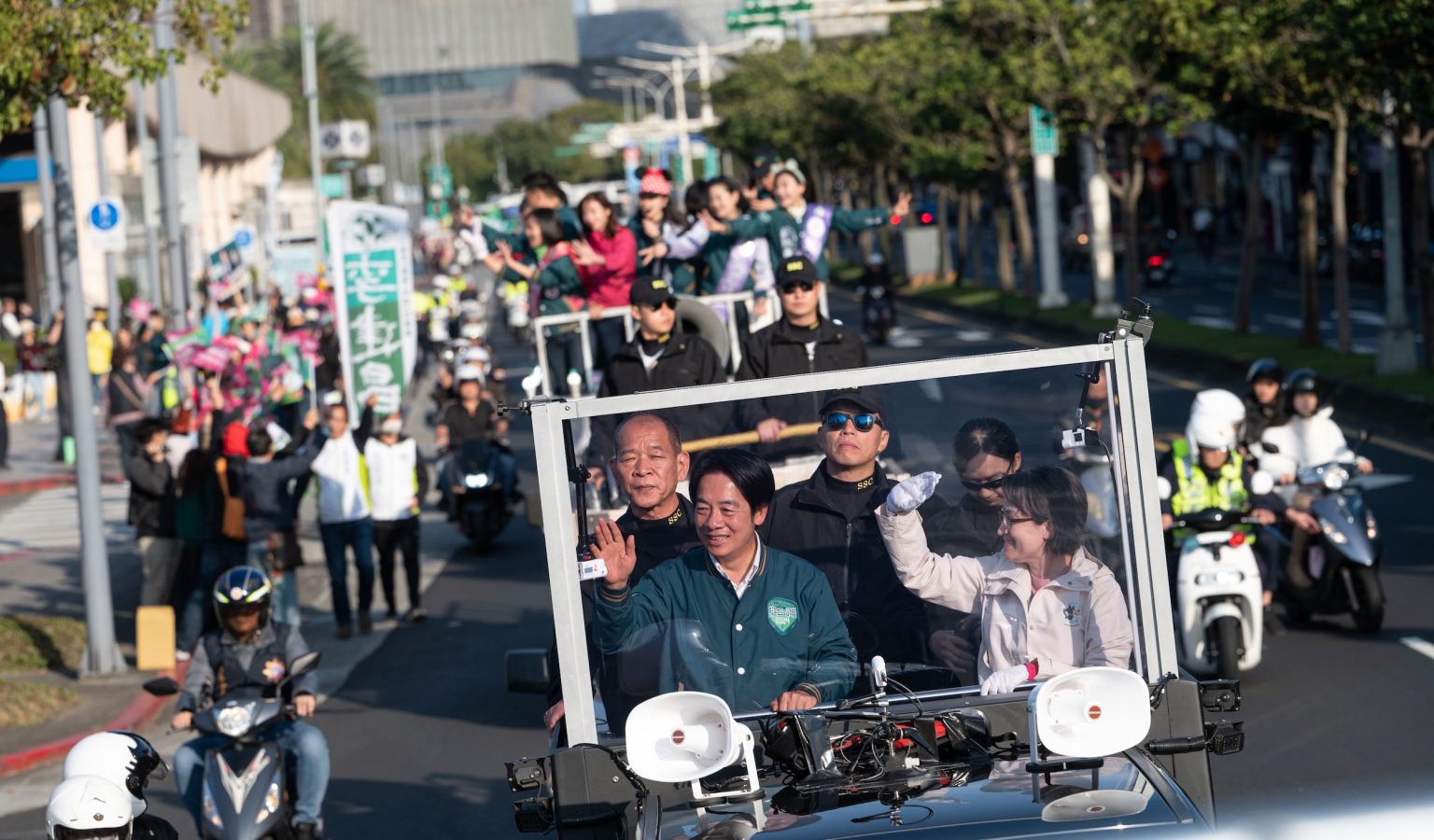
The biggest worldwide election year in history was rapidly approaching, and both Numbers and Starling Lab wanted to develop a tool that could easily be used by journalists to collect, annotate, organize, corroborate, and most importantly, authenticate their photojournalistic work.
In addition, the project aimed to address two key challenges: enabling journalists and citizens to share verifiable media with provenance, and providing a way for journalists to license their content internationally, especially outside of Taiwan.
As AI deepfakes and misinformation campaigns loom large, the two technical teams prepared by providing and testing tools to help the truth rise to the top amid an onslaught of information.
Contents
The Prototype
For this project, we collaborated with our friends Numbers to test out two custom-built solutions for photojournalists, each with a distinct purpose and real world applications.
Photojournalism Licensing Platform
One of the primary goals was to try out a prototype licensing platform during a real election cycle. We wanted to test a product to assess how blockchain-based content integrity tools and monetization options could be applicable and useful during impactful real-world events. Numbers Protocol is continuously developing and improving on products for journalists, and wanted to use this opportunity with the Taiwanese elections to test and demonstrate how a verified dashboard could be used as a tool for both journalists and everyday citizens to document and share photos (with authenticity information) to show what was really happening before and during the elections.
To fulfill this objective, the project leaned on Numbers Capture, a service platform designed not only for capturing verifiable media but also for enabling journalists to monetize their work. Built with concepts from the Starling framework, Numbers Capture was developed for both professionals and individuals, allowing journalists to license and share authenticated media globally.
Collaborative Investigation Tool
Another major objective was providing investigators with a private, shared environment to securely gather and corroborate cryptographically verifiable digital evidence. We aimed to test whether a prototype Content Management System (CMS) could successfully:
- Enhance investigations using multiple sources of truth (attestations and metadata).
- Improve trust by providing traceable authenticity data.
- Help journalists aggregate media, like photos and web archives, to corroborate peer reporting and fully contextualize events.
To accomplish these investigative goals, we tested the Uwazi + Authenticated Attributes platform. This custom tool enables journalists to build a shared base of evidence, corroborating media while demonstrating cryptographic proof of provenance. We tested if users could effectively share capture information and utilize an interface that displays multiple layers of authenticity data for a single asset.
Though each platform serves a different primary purpose – with Numbers Capture built for public sharing and licensing, and Uwazi designed for private investigation – both share a common mission. As generative AI and social media make it increasingly difficult to differentiate fact from fiction, both projects provide vital tools for truth during a year of high-stakes global elections.
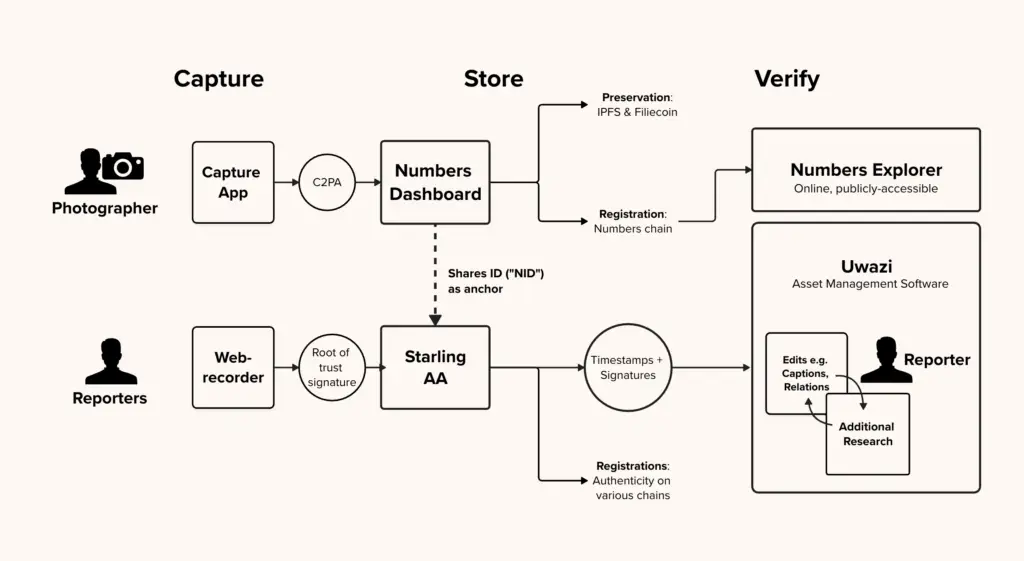
The diagram above represents the flow of data from capture to verification and investigation as well as publication.
Contents
Technology
Throughout the process following the Starling Lab Framework, authenticated information can be added to digital media at multiple stages, and not only at the point of collection. After testing various methods of capture and verification, it became apparent that establishing a strong provenance trail also requires authenticating subsequent metadata updates and preserving contextual information from the initial capture all the way through to its presentation to an audience.
Each platform in this project added and preserved authenticity information at different parts of the process outlined by the Starling Framework.
Capture
The project focused on capturing two primary types of data during the Taiwanese elections. First, participating photojournalists captured original, on-the-ground media, specifically photos, videos, and rich provenance metadata (such as time, location, and device information) generated directly at the source. Second, the team captured point-in-time web archives of published news articles reporting on the same political events.
Numbers Capture Cam App
To record media, users can take photos or short videos using the Capture Cam app, available on both Android and iOS platforms. Alternatively, users can shoot with their own cameras and subsequently upload the files via the desktop Capture Dashboard to secure an integrity proof on the blockchain. All files captured or uploaded through these tools embed C2PA metadata within the file and generate a blockchain integrity record.
For this project, the Numbers Capture was the source of initial capture for both platforms tested. Photojournalists uploaded their photos into the Capture Dashboard, which was the initial source of metadata and authenticity information (see below):
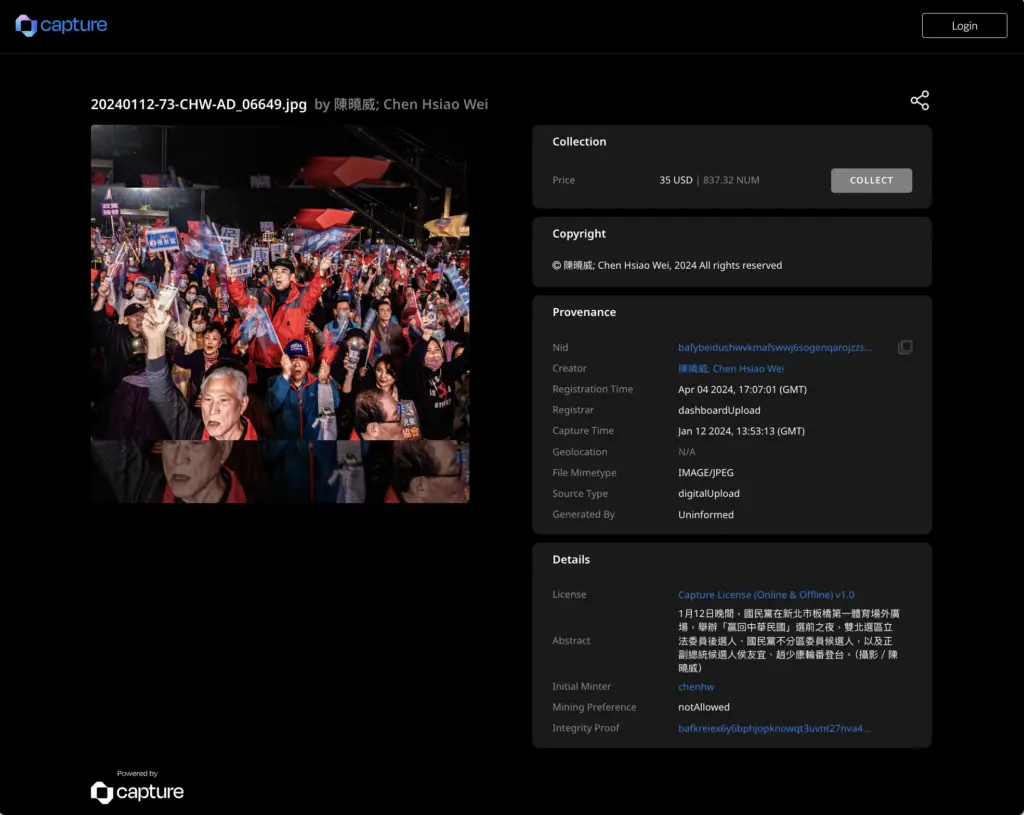
This platform was developed at a critical time to provide auditing tools to help determine the authenticity of digital information amidst the threat of mis- and disinformation during election campaigns. Designed for both journalists and civic participants, it also serves as a monetization tool, allowing reporters (especially those without an established international reach) to license and sell their digital media worldwide. News outlets typically rely on reporters with whom they have established relationships for international coverage; this platform bridges that gap by providing citizens and independent journalists a way to share information that can be easily inspected and audited by professionals.
Here’s one of the original photographs in the Capture Dashboard.
Authenticated Web Archives
In this project, Starling Lab also used the Webrecorder web archive creation tool to capture various articles about the Taiwanese elections, and put these files in a separate Authenticated Attributes database, and made references to photos that had imagery of the same event featured in the article. These WACZ files were signed by a different entity, and an example of how an ‘attestation’ can be made about another piece of content. Investigators would be able to see that the WACZ file is related to certain images from the journalists, the relationship being another type of information captured in this project.
WACZ files are point-in-time files that the Webrecorder suite of tools used to capture a website in its entirety. These files can be ‘replayed’ and interacted with the same way you would with a live webpage. These can capture any embedded media in an article such as videos or comments, as well as bundle several linked pages together, enabling an end user to experience the site as it was captured.
Store
To counter risks related to centralized storage, the project experimented with a decentralized storage architecture built on content addressing. Traditional web storage points to where a file lives (like a URL or a specific folder on a server), making it highly vulnerable if that server is attacked, altered, or goes offline. In contrast, the Numbers Capture solution evaluates the actual pixels and metadata of the image to generate a unique Content Identifier (CID), known in their system as a Nid. This Nid acts as an unforgeable cryptographic fingerprint; if a single pixel is altered by a bad actor, the fingerprint changes, instantly alerting users to the manipulation.
Decentralized Media and Metadata Anchoring
When photojournalists uploaded their assets, the storage was handled through a bifurcated approach to maximize security and efficiency:
- The Media: The heavy digital files—such as high-resolution photos and web archives—were distributed across IPFS (InterPlanetary File System) and Filecoin. This ensures the underlying media remains robustly accessible across a global, decentralized network of nodes, immune to localized server outages or targeted takedowns.
The Metadata: The lightweight, verifiable key metadata is securely anchored on the Numbers blockchain. Transforming the registered files into decentralized Web3 assets ensures that no single central authority can secretly alter the historical record.
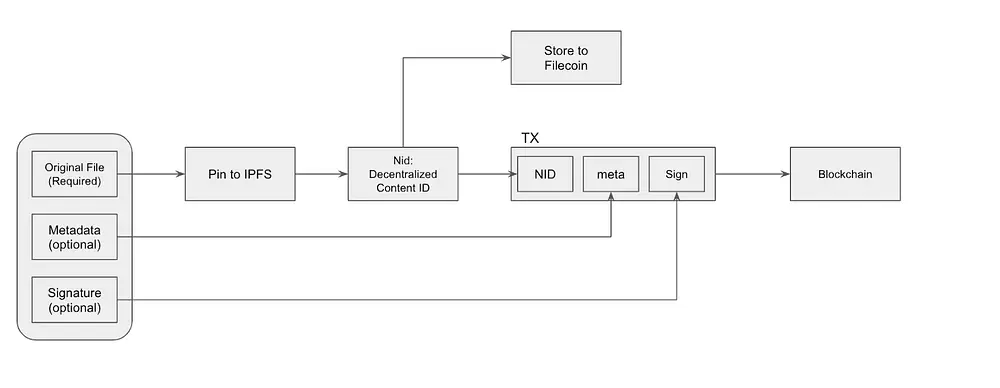
AssetTrees and Immutable Edit History
In journalism, an asset’s context often evolves after it is published—captions are updated, new locations are verified, and relationships between files are discovered. To handle this without breaking the provenance trail, asset metadata is organized into AssetTree files.
Properties such as the creator, creation time, and license form the foundation of the tree, while new metadata updates can be appended as “leaves.” When a journalist makes a change, a new commit is created on the blockchain. This generates an updated AssetTree file reflecting the new state, while permanently retaining the Nid of previous versions. This structure allows investigators to inspect the complete lifecycle and alteration history of the asset, ensuring total transparency.
Finally, this foundational Nid is fed into Starling Lab’s Authenticated Attributes database. This allows the Uwazi CMS to seamlessly reference the blockchain identifier and pull the fully authenticated, tamper-proof record into a shared workspace for investigative teams.
Verify
If the “Store” phase is about securing the data, the “Verify” phase is about making that data visible, usable, and trustworthy for the end-user. In an election environment saturated with generative AI and coordinated misinformation, simply having a secure backend is not enough. Journalists and citizens need intuitive interfaces to inspect digital evidence, corroborate claims, and prove authenticity. To achieve this, the prototype tested two distinct verification environments: one for public transparency, and one for private, collaborative investigation.
Public Verification: Numbers Explorer
For public-facing verification, the prototype utilized the Numbers Explorer. Because every asset processed through Numbers Capture generates a unique Nid, journalists could simply append this identifier to the Numbers Explorer URL or click it within the Capture Dashboard. This allows anyone—from a skeptical reader to a fellow reporter—to view the asset’s public integrity proofs, inspect its blockchain commit history, and verify that the image has not been manipulated since the moment of capture.
Collaborative Investigation: The Uwazi CMS
For deep, collaborative investigations, Starling Lab utilized Uwazi, an open-source Content Management System developed by HURIDOCS. Originally designed for human rights defenders to organize vast collections of evidence, Uwazi provided the perfect foundation for a shared journalistic workspace. Starling Lab enhanced a self-hosted instance of Uwazi by integrating the Authenticated Attributes service, bridging the gap between a traditional CMS and Web3 cryptography.
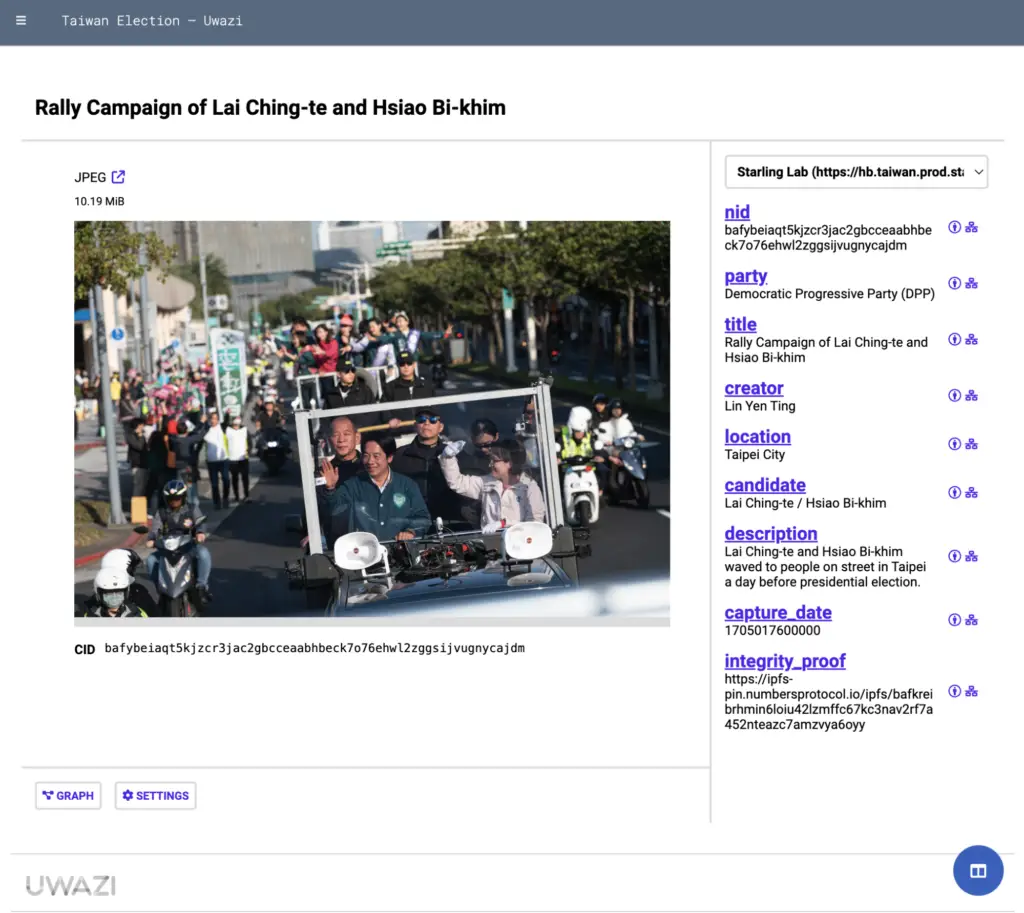
To test the efficacy of this system in a real-world scenario, four Taiwanese photojournalists were invited to use the custom Uwazi interface to organize their election coverage. They used their Nids to pull their verified assets from the Numbers Dashboard directly into Uwazi, mimicking a high-stakes collaborative newsroom environment.
Cross-Referencing the Evidence
The true breakthrough of the Uwazi prototype was its ability to seamlessly connect different types of authenticated media. The system hosted two distinct databases side-by-side:
- The Journalist Database: Containing the photojournalists’ on-the-ground imagery, complete with metadata such as candidate names, locations, and cryptographic signatures.
- The Web Archive Database: Housing the point-in-time WACZ files of published news articles covering the exact same election events.
By bringing these two datasets into a single interface, Authenticated Attributes enabled journalists to draw direct connections between them. A reporter could view a cryptographically verified photograph of a political rally and immediately cross-reference it against an authenticated web archive of a news article reporting on that same rally. This layered verification provides a comprehensive, tamper-proof view of an event, allowing investigative teams to effectively counter false narratives and establish a definitive historical record of the 2024 Taiwanese elections.
Contents
Learnings
To evaluate the practical value of these prototypes, four Taiwanese photojournalists participated in a guided survey and task-based testing within the custom Uwazi + Authenticated Attributes interface. The goal was to determine if an authenticated Content Management System could actively improve their investigations and if the complex cryptographic data generated by tools like Numbers Capture could be easily understood by non-technical users.
Overall, the journalists expressed a strong, active interest in platforms that can help discover and identify authentic media, specifically because they are witnessing mis- and disinformation campaigns impacting Taiwanese elections firsthand. However, the testing revealed a critical gap between providing raw cryptographic proof and presenting that proof in a way that is journalistically actionable.
The “Translation” Challenge: Cryptography vs. Journalism
To evaluate the practical value of these prototypes, four Taiwanese photojournalists participated in a guided survey and task-based testing within the custom Uwazi + Authenticated Attributes interface. The goal was to determine if an authenticated Content Management System could actively improve their investigations and if the complex cryptographic data generated by tools like Numbers Capture could be easily understood by non-technical users.

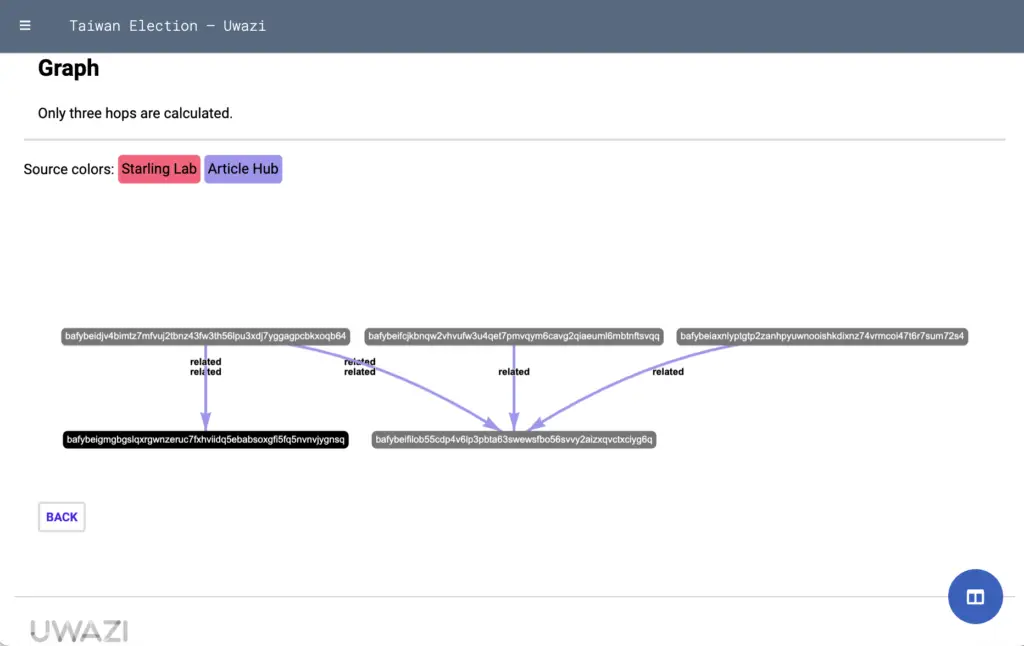
This friction extended to the failed graph view. The system included a visual graph meant to show the relationships between different digital assets and web archives. However, because the graph’s nodes were labeled with Base64-encoded Content Identifiers (CIDs), the visual was unintuitive and went completely unused by the participants. Ultimately, this feedback highlighted a fundamental reality of newsrooms: trusting people, not math. Journalists recognize and trust individuals and organizations, but they do not necessarily understand or value the raw cryptography behind them.
Archival Fidelity and Interface Friction
The prototype also revealed interesting insights regarding how journalists interact with web archives and the general CMS workflow. One unexpected outcome was the web archive illusion. The Webrecorder (ReplayWeb.Page) archives were so high-fidelity that journalists did not realize they were looking at preserved, point-in-time archives. Despite the unique UI of the Replay platform, their comments indicated they believed they had simply clicked a link to a live website.
For the Numbers Capture platform, ensuring an intuitive interface is crucial because photojournalists frequently upload batches of photos late at night after covering fast-paced election rallies. Any friction in the upload or tagging process becomes an immediate barrier to adoption. Finally, the team encountered language and context barriers.
Some lack of understanding stemmed from the platform being built in English, creating a language barrier for the Taiwanese journalists. Participants also noted that the platform required better search and discoverability features to manage larger datasets effectively.
Strategic Recommendations for Future Platforms
Based on this real-world election deployment, future iterations of investigative archival platforms must bridge the gap between secure engineering and accessible design.
To humanize the cryptography, public keys and cryptographic signatures must be translated into human-readable information, explicitly displaying the verified name or organization of the key owner rather than a string of code.
Developers must also explain the tech within the interface itself; data like Attestation CIDs that tie assets to blockchain registrations should not just be linked, but their function and value to the investigation must be clearly explained to the user.
Regarding web archives, the mantra should be to embed, don’t link. To prevent users from mistaking a web archive for a live site, WACZ files should be embedded directly within the CMS viewer rather than requiring a link out to an external Replay portal.
Ultimately, the goal is to democratize access. Platforms must prioritize a frictionless, localized user experience that caters not only to professional newsrooms but also to civic participants and citizen journalists, whose unique perspectives are vital during democratic elections.
Contents
Additional Resources
Numbers Blog: This official post from Numbers Protocol details how their decentralized archiving and blockchain technology were actively deployed to verify media in the 2024 Taiwanese elections.
Starling Dispatch: Starling Lab’s official newsletter outlines their strategic partnership and the implementation of the Starling Framework to combat deepfakes and establish a cryptographically verified historical record.
Journalism.co.uk: This industry news article highlights the launch of the blockchain verification tool as a critical, real-world resource for journalists fighting AI-generated deepfakes in global elections.
Politico EU: This report underscores the intense geopolitical stakes of the prototype by detailing the massive, state-sponsored fake news campaigns bombarding Taiwan ahead of the vote.
AmCham Taiwan: This piece provides broader regional and systemic context regarding the ongoing defensive strategies required to fight against election-related disinformation in Taiwan.
AP News: This comprehensive news report covers the fundamental political dynamics and cross-strait tensions of the election, illustrating the volatile environment in which these verification tools were deployed.