


Proposing An ‘Index For Accountability’ To UN Human Rights Chief
The work of documenting human rights abuses is inherently decentralized, reflecting the diversity of civil society organizations and monitors working tirelessly in conflict zones and beyond. This natural fragmentation is not a shortcoming but a testament to the resilience and independence of these groups. However, within this diverse ecosystem lies the potential to amplify impact through better coordination and interoperability. By respecting the unique contributions of each actor while fostering collaboration, we can explore ways to transform these decentralized efforts into a cohesive force for justice and accountability.
The Starling Lab for Data Integrity, in collaboration with Hala Systems, have jointly submitted a comprehensive proposal to the United Nations Office of the High Commissioner for Human Rights (OHCHR). This document outlines a new vision for using digital technology in the administration of justice, particularly focusing on enhancing the management and utilization of digital evidence in conflict zones like Ukraine.
We believe our proposed design and prototype software, called Index for Accountability, can enhance the authenticity and reliability of digital evidence, making it a powerful tool in the pursuit of justice.
The Index is underpinned by Starling’s research and prototypes for associating digital assets and their metadata, which we call Authenticated Attributes. Our proposal to the United Nations also rests on our principles of “Authenticity by Design” which place provenance and integrity data front and center in the architecture of information-gathering tools.
Starling and Hala had previously made submissions to the UN with documentation of attacks against schools in both Ukraine and Syria (with Russia among the alleged perpetrators in both conflicts), along with recommendations for the long-term preservation and authentication of that evidence. Like the new submission, the prior ones leveraged a series of advanced technologies including cryptography, and decentralized systems. The undertaking is part of an ongoing effort to help the international legal community hold perpetrators to account for acts that deprived children of their right to education.
Supporting Justice with Digital Technology
An original collaboration and consortium including Bellingcat, Hala Systems, Ukraine War Archive, Benetech, Airwars, and Mnemonic, the Index for Accountability seeks to acknowledge the fragmentation of digital evidence archives while offering a secure framework for evidence management. This can turn traditional challenges into strengths for the administration of justice.
The original goals of the tool go back some years, and have been supported by, among others, a concept note and proof of concept from Benetech, and initial user research by Interstitial – both circulated to members of the consortium.
In essence, the Index is a software-driven collaboration designed to simplify accessing and sharing digital evidence. It is intended for participants seeking to support atrocity crimes investigations in conflict zones. The tool is designed to facilitate the sharing of evidence collected by civil society and monitoring organizations, including with UN mechanisms, while ensuring that archive creators and holders retain control over their specific evidence and the ability to manage their consent for participation in networks and engagement with new entrants.
Our prototype of the Index has been integrated with the digital asset management system Uwazi, which is popular among investigators of human rights violations.
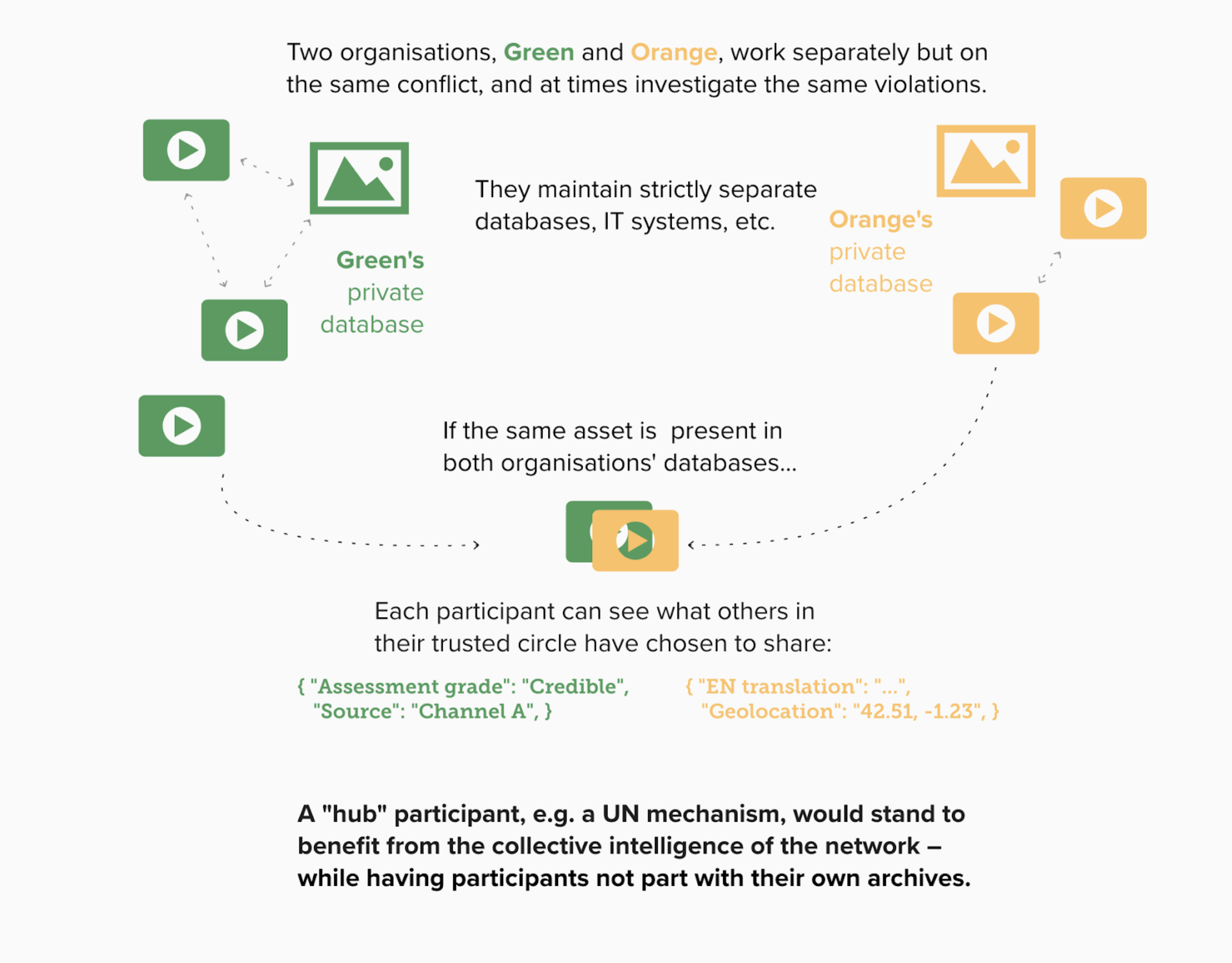
The approach of the Index, which protects the files and evidence itself with state-of-the-art provenance and custody markers, enables collaborative workflows whereby teams, or separate organizations, can effortlessly share some parts of their data – or rather let others effortlessly discover some of the data they have created and curated.
In the following example, two organizations who trust each other share metadata they create (description of the item, geolocation of a photograph, etc.) in a system, making the data discoverable by the other organization – provided the other holds the exact same photograph in their database:
Transformative Benefits and Implementation
The Index for Accountability (IfA) is designed to deliver substantial benefits to justice systems:
- Streamlines Justice Processes: The IfA simplifies the collection, sharing, and analysis of digital evidence, optimizing resource use.
- Enhances Evidence Integrity: By improving the reliability and consistency of evidence, the Index ensures a fairer administration of justice.
- Encourages Global Collaboration: The framework fosters respectful international collaborations, strengthening global justice efforts.
- Supports Broader Justice Goals: As a neutral and authoritative initiative, the IfA aids in truth-seeking and the establishment of collective memory.
The Index prioritizes privacy and incorporates Authenticity By Design, safeguarding data integrity and confidentiality to uphold human rights. It ensures equal access and participation, supporting fairness and non-discrimination. The IfA also includes measures for accountability and remedies for violations related to digital technology use in justice administration.
Earlier last year, Starling Lab and Hala Systems submitted related materials to prosecutors at the International Criminal Court as evidence of potential war crimes.
Basile Simon, accountability lead at Starling Lab, said:
“Once again we are privileged to work with Hala Systems, and to present our work to the UN. Our research into usable and portable authenticated data overlaps with the OHCHR’s public call for contribution about the administration of justice. We believe that a decentralized architecture uniquely fits the priorities and concerns of civil society organizations seeking to efficiently communicate their evidence with the United Nations. We call on the UN and its Mechanisms to consider implementing and being a leader of this project.”