


Witness Servers
2023

Establishing institutional trust and technical corroboration for web evidence through decentralized, simultaneous crawling and cryptographic signatures.
YEAR
2024
PARTNERS
Webrecorder
FFDW
Harvard Library Innovation Lab
LINKS
– Concept note and Call for Contributions
– Our whitepaper on best practices in web archiving
The Problem
Minute, technical, cosmetic errors plague efforts of open source monitors who scour the Web and archive its content. In the context of legal investigations, these minor defects are considerable challenges to the reliability of the artifacts, and thus to the facts they aim to prove. Moreover, small organizations and individual investigators face a greater burden in arguing the probative weight of the material they collect than large, reputable, and established institutions.
The Solution
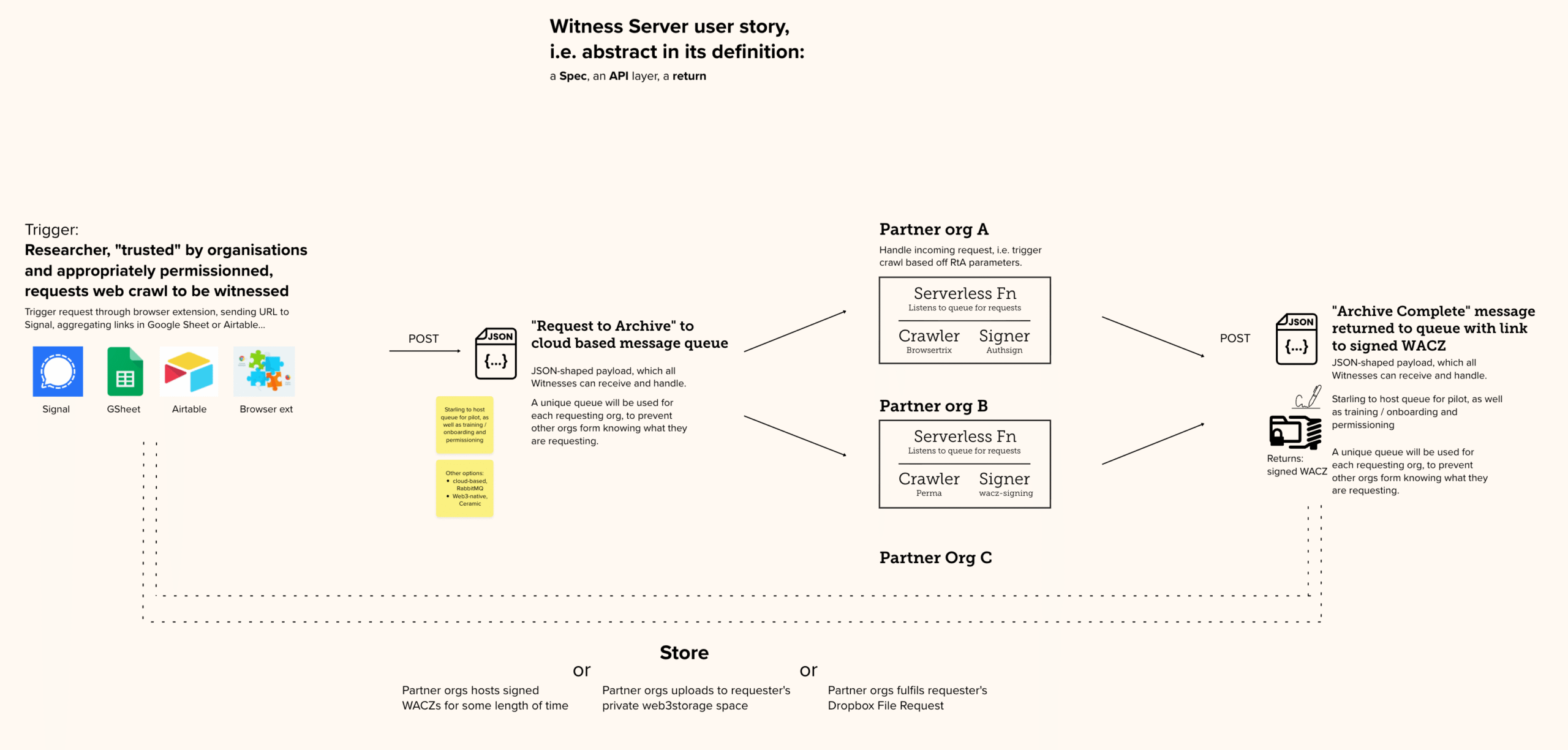
We are developing the Witness Server prototype To replicate social trust in digital capture by involving reputable institutions as simultaneous observers of the web.
In short: a Witness Server is a service hosted by an institution that conducts on-demand web crawls. When a researcher initiates a local capture, a request is simultaneously dispatched to several partner Witness Servers (such as Harvard LIL or the Atlantic Council). Each institution performs its own crawl independently using its own infrastructure, creating a multi-perspective record of the same web content at that exact moment.
The prototypes follow all our learnings about web archives, Including the use of the WACZ open source format which bundles signed and hashed files.
By comparing multiple institutional archives, investigators can explain away non-material “cosmetic” defects (like pop-up banners) and provide overwhelming proof of the core content’s authenticity.
REFERENCE IMPLEMENTATION
On Github →


Still Photogrammetry
2023
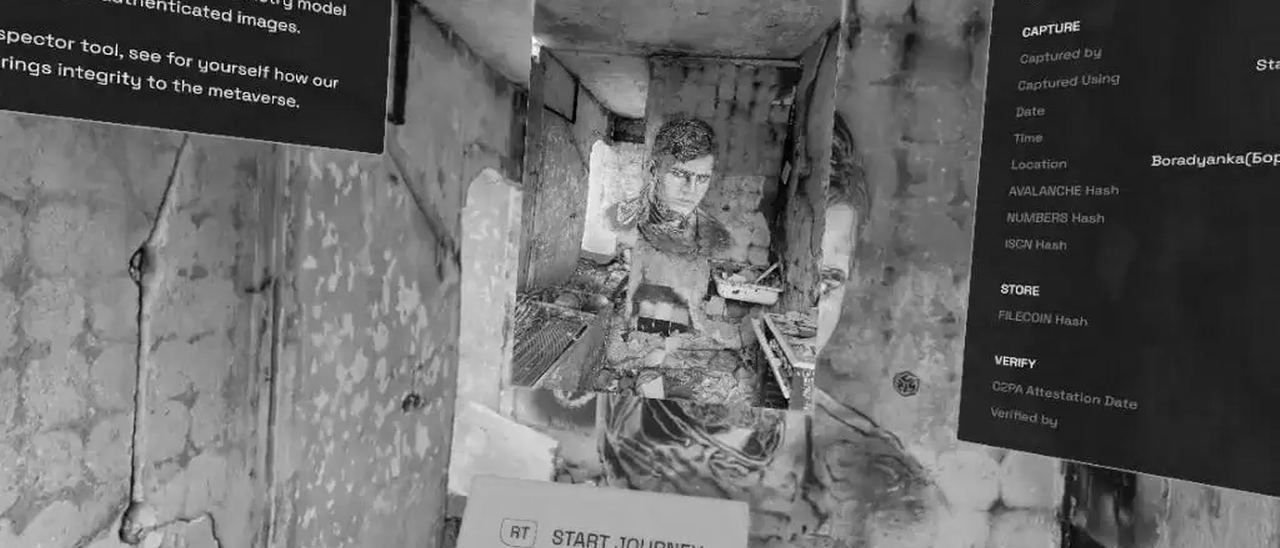
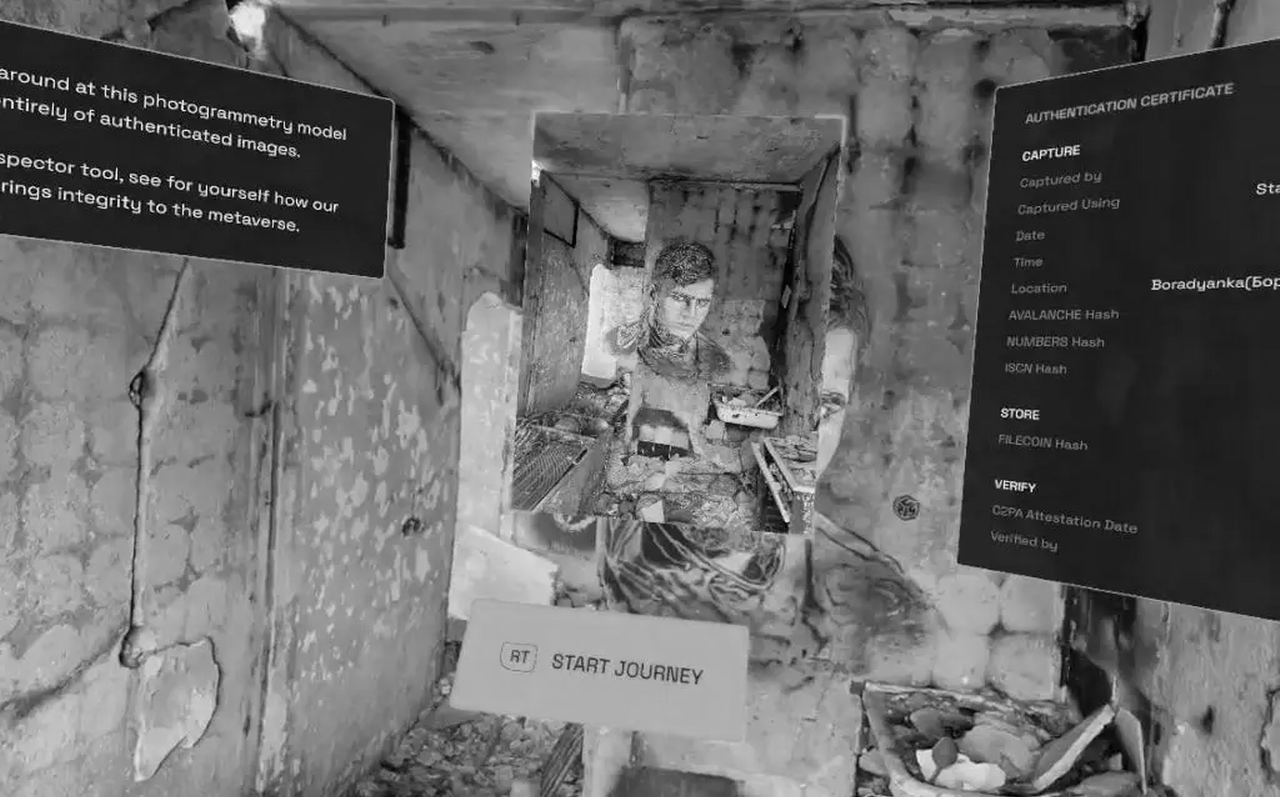
Still Photogrammetry integrates authenticated metadata with 3D spatial reconstruction to provide a verifiable record of physical environments and historical sites.
By utilizing a decentralized framework where every source image is treated as an independently verifiable “atom” of fact, this prototype allows investigators to build unalterable, three-dimensional timelines of evidence. It anchors complex digital twins to a cryptographic “proof of existence,” proving that the spatial data has not been tampered with since the moment of capture and restoring trust in digital primary sources for law and journalism.
YEAR
2022-26
PARTNERS
Mike Caronna
Pixelrace
Artem Ivanenko
LINKS
The New Horizon Lab
Starling Lab’s Spatial Digest
The Problem
Techniques such as photogrammetry (and more recently, NeRF and Gaussian Splatting) permit the reconstruction of a space in 3D, from stitching together 2D photographs. These tools are key to both extended reality environments and to investigations driven by architectural practices. However, integrity and provenance data is lost in the computing that renders the 3D models.
The Solution
Starling experiments with capture techniques supportive of 3D reconstruction while including provenance and integrity markers. From using smartphones to professional DSLRs, we test the technical constraints against the needs of photogrammetry workflows, which require a large amount of photographs of the scanned location.
Furthermore, we are also prototyping virtual UIs in virtual reality aiming to bridge the gap between what the viewer can see (the 3D model) and the original location (as per the 2D photographs). The viewer can navigate the space and select these authenticated “anchors” to interrogate the model, furthering their trust in the reconstruction.
SELECTED WRITING
Our 2025 paper: Verifiable Reality: Contrasting Approaches to Photorealistic VR Using NeRF Streaming and Gaussian Splatting Technologies

SD Card Encryption
The Problem
Losing control of data can happen when journalists, historians, or legal experts least expect it. SD cards can be seized during border crossings, left behind in a taxi, or stolen from a hotel room. Evidence that has been captured on an SD card, and which has not yet been anonymized, might carry geolocation or identity information that can lead authorities or militants to vulnerable people being photographed or interviewed. Another risk to unencrypted data on an SD card is that it could be manipulated undetected when not in one’s possession, with files erased or modified.
Prototypes are being tested by Starling Lab that both encrypt and hide important data captured by those in the field.
The Solution
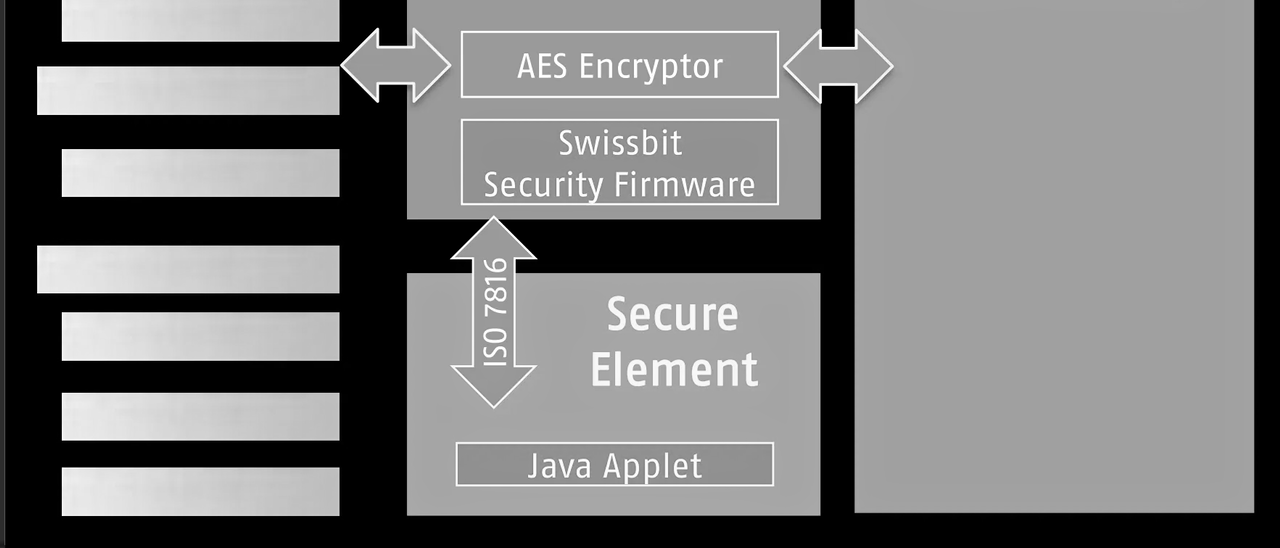
Starling Lab is collaborating with industry partners including Swissbit, a leader in secure storage, to deploy hardware-encrypted SD cards that protect media the moment it is written to disk. This prototype ensures that digital assets are secured independently of the camera’s software vulnerabilities.
The solution creates an “encrypted tunnel” between the camera lens and the storage medium. Swissbit’s hardware-based encryption automatically protects image and video data without requiring additional software on the capturing device, ensuring that media cannot be manipulated or viewed in transit.
To protect the safety of practitioners in the field, the prototype relies on hidden partitions on the SD card. Sensitive files are stored in a manner that makes them impossible for unauthorized parties to discover or decrypt (even if the physical card is seized and inspected), while providing a critical layer of plausible deniability.