Still Photogrammetry

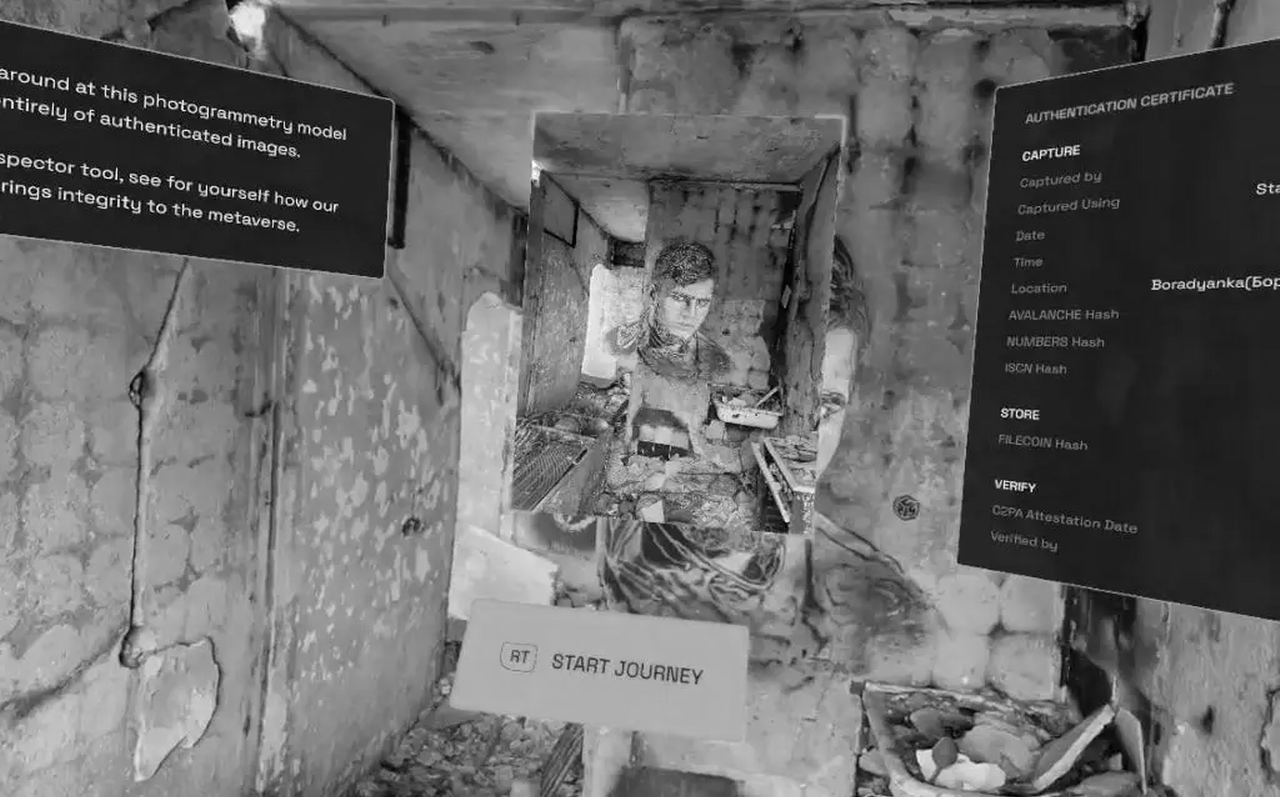
Still Photogrammetry integrates authenticated metadata with 3D spatial reconstruction to provide a verifiable record of physical environments and historical sites.
By utilizing a decentralized framework where every source image is treated as an independently verifiable “atom” of fact, this prototype allows investigators to build unalterable, three-dimensional timelines of evidence. It anchors complex digital twins to a cryptographic “proof of existence,” proving that the spatial data has not been tampered with since the moment of capture and restoring trust in digital primary sources for law and journalism.
YEAR
2022-26
PARTNERS
Mike Caronna
Pixelrace
Artem Ivanenko
LINKS
The New Horizon Lab
Starling Lab’s Spatial Digest
The Problem
Techniques such as photogrammetry (and more recently, NeRF and Gaussian Splatting) permit the reconstruction of a space in 3D, from stitching together 2D photographs. These tools are key to both extended reality environments and to investigations driven by architectural practices. However, integrity and provenance data is lost in the computing that renders the 3D models.
The Solution
Starling experiments with capture techniques supportive of 3D reconstruction while including provenance and integrity markers. From using smartphones to professional DSLRs, we test the technical constraints against the needs of photogrammetry workflows, which require a large amount of photographs of the scanned location.
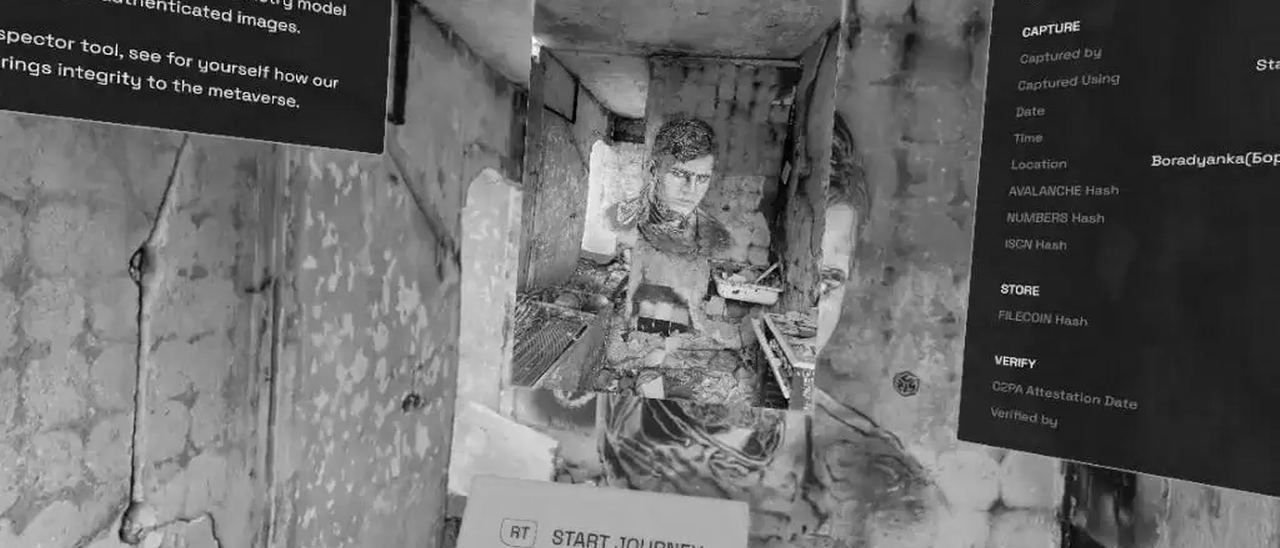
Furthermore, we are also prototyping virtual UIs in virtual reality aiming to bridge the gap between what the viewer can see (the 3D model) and the original location (as per the 2D photographs). The viewer can navigate the space and select these authenticated “anchors” to interrogate the model, furthering their trust in the reconstruction.
SELECTED WRITING
Our 2025 paper: Verifiable Reality: Contrasting Approaches to Photorealistic VR Using NeRF Streaming and Gaussian Splatting Technologies