


Supervisory Testimony as a Novel Tool for Accountability
The testimony of a primary observer’s supervisor could help bridge evidentiary gaps. Supervisory testimony would consolidate the institutional knowledge of the chain of custody of specific pieces of digital evidence with a single person.
Criminal investigations depend on evidence gathered in the field. Unfortunately, these scenes can be difficult to access (ex: war zones, disaster areas) and individuals on the ground may not be accessible to courts (ex: threats to safety, loss of contact). Emerging technologies could help overcome such challenges, providing novel solutions to weigh probative value and establish authenticity.
In the summer of 2021, and as part of the Human Rights and International Justice Policy Lab at Stanford Law School, the Starling Lab and Hala Systems convened a group of international experts on digital evidence and war crimes prosecutions to solicit feedback on their proposed model of Supervisory Testimony.
The gathering was chaired by Beth Van Schaack (then visiting professor at Stanford), assisted by Mackenzie D Austin (then Lab associate).
Problem: Authentication and chain of custody of digital evidence registered on a distributed ledger
Data (including multimedia assets like photo and video) that is collected by field observers can present a number of evidentiary and admissibility issues when that data is submitted in accountability settings. Because of the ad hoc nature of evidence collection in conflict zones, the chain of custody of individual pieces of digital evidence can be especially hard to trace. Furthermore, a variety of custodians might have handled evidence before it reaches a host organization or tribunal, which can be difficult to track as well. The extended period of time between evidence collection, storage, and admission into evidence also presents the possibility that many primary observers and custodians may no longer be reachable by the time that accountability processes take place. Thus, those individuals would not be able to provide critical affidavits or testimony as to the veracity and authenticity of the digital evidence at the time of trial. All of these factors threaten the admission of digital evidence in a court of law.
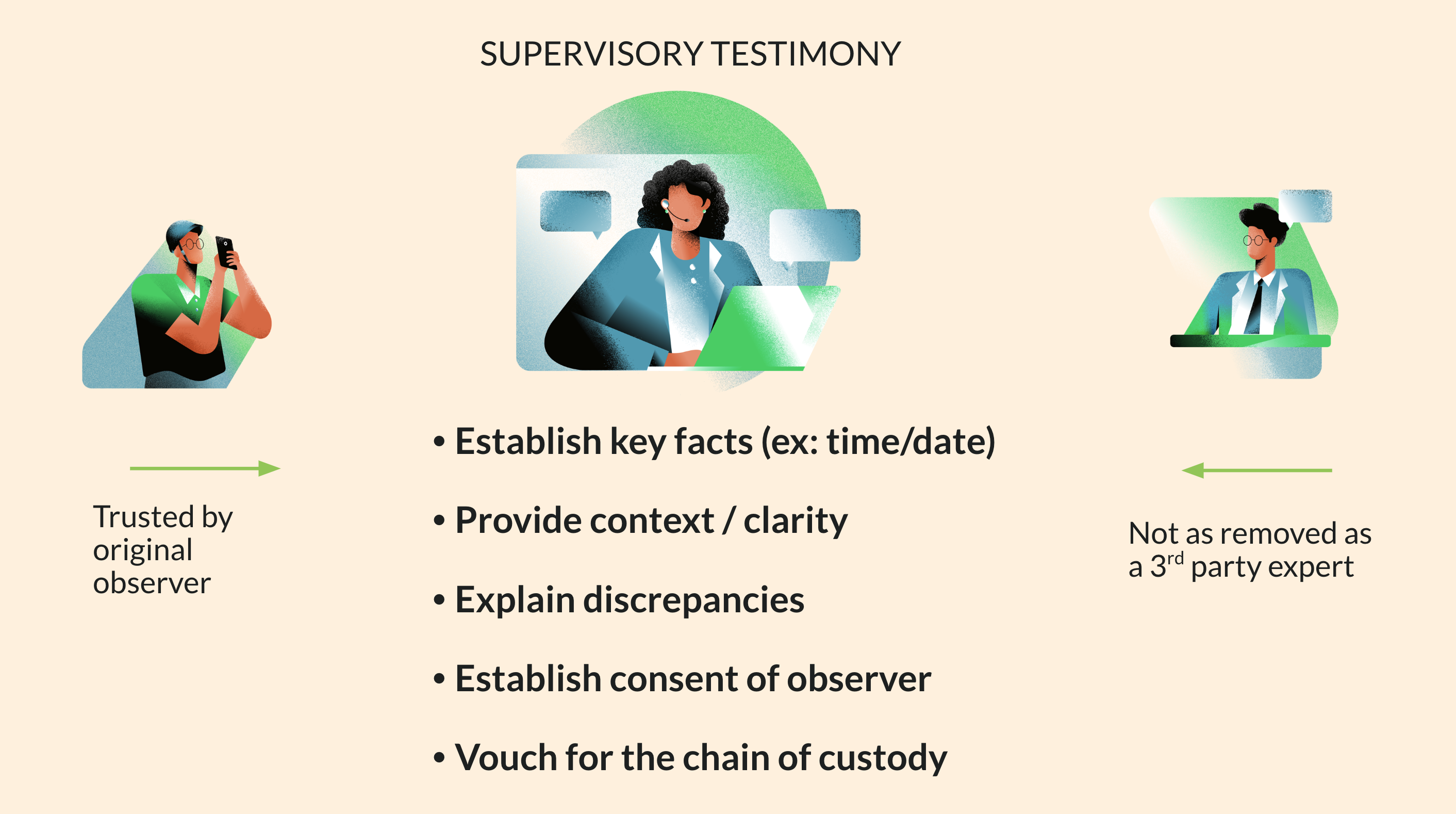
Proposed Solution: Supervisory Testimony
Supervisory testimony, or the testimony of a primary observer’s supervisor (who may participate remotely), could help bridge the evidentiary gap. Rather than requiring a different witness to account for each individual link in the chain of custody, a single supervisor could account for the entire chain of custody. Supervisory testimony would consolidate the institutional knowledge of the chain of custody of specific pieces of digital evidence in a single person.
For example, a supervisor would be tasked with training and overseeing a set of field observers. During a years-long conflict, the supervisor would keep track of the provenance of the swaths of digital evidence submitted by their cohort of observers. Once an accountability mechanism (e.g. a tribunal) is initiated, that single supervisor would present a consolidated bundle of data (e.g. photographs) obtained by their field observers. As a witness, the supervisor would testify as to the chain of custody of specific pieces of evidence, having been present as a supervisor during the collection and storage process. That supervisor would also explain the general process of capture and transfer of all recorded data functions, including the training of field observers. Most importantly, that supervisor would provide a blanket certification of authenticity of the digital evidence. Ultimately, a single supervisory witness could stand in for the dozens of field observers who collected the data over an extended conflict and account for the entire lifecycle of digital evidence from the moment of capture to its presentation in court. This strikes an important balance, streamlining several obstacles to evidence admission while still allowing a defendant an appropriate party to cross-examine.
Technological solutions like cryptographic hashes and distributed ledger entries have been pitched as solutions for chain of custody concerns, serving a bit like a notary system. However, those solutions may be insufficient to adequately account for the human observers whose testimony may still be necessary to authenticate digital evidence. Instead, the combination of technological authenticity markers and supervisory testimony would help shore up any gaps in the chain of custody and enhance authentication for accountability purposes. While technological solutions will be discussed, the workshop has primarily explored how both human and technological protocols are essential. Together, these robust protocols could be a new frontier in authentication.

Possible Implementation Methods
- Asynchronous supervision: A supervisor would train new cohorts of field observers with an established protocol to ensure the authenticity of the collected data and reliability of the collection methods. This could include corroborating data, like photos or videos of the field process itself. A supervisor could also conduct debriefs with their observers to affirm that the collection protocol was followed at the time that specific evidence was collected.
- Direct supervision synchronous with the moment of capture: For example, a supervisor may text back and forth with a field observer at the moment they collect evidence. Alternatively, the field observer may livestream the evidence collection with their supervisor.
- Development of uniform collection protocols: Hosting organizations that employ supervisors must develop uniform collection protocols to be used in the field. As part of these protocols, organizations should also contemplate ways to maintain impartiality and neutrality in the collection of their data, and consider common or likely rules of evidence.
-