

The Post-Photographic Age Is Here. What Does That Mean for Trust?
For over 180 years, photographs have served as evidence. A photograph was understood to be a mechanical recording of light that existed in a specific place at a specific time. In other words, proof of the existence of an object or event. This evidentiary assumption underpins journalism, law enforcement, insurance claims, scientific research, and countless other domains. With the advent of AI-generated synthetic imagery, that assumption is now obsolete.
This is not a new problem. Photography itself was once a disruptive technology. Before cameras, courtroom evidence was testimony and physical objects. Early photographs faced skepticism. Could they be trusted? Were they accurate? Over decades, societies developed frameworks: chains of custody, expert authentication, standards for admissibility. We’re at a similar inflection point now.
Today’s emerging technologies have different names — Gaussian splatting, Neural Radiance Fields, diffusion models, world models — but they share a common capability: they can create imagery that never existed. What makes this moment different is that it has made obvious how fragile our systems of trust and authenticity have always been.
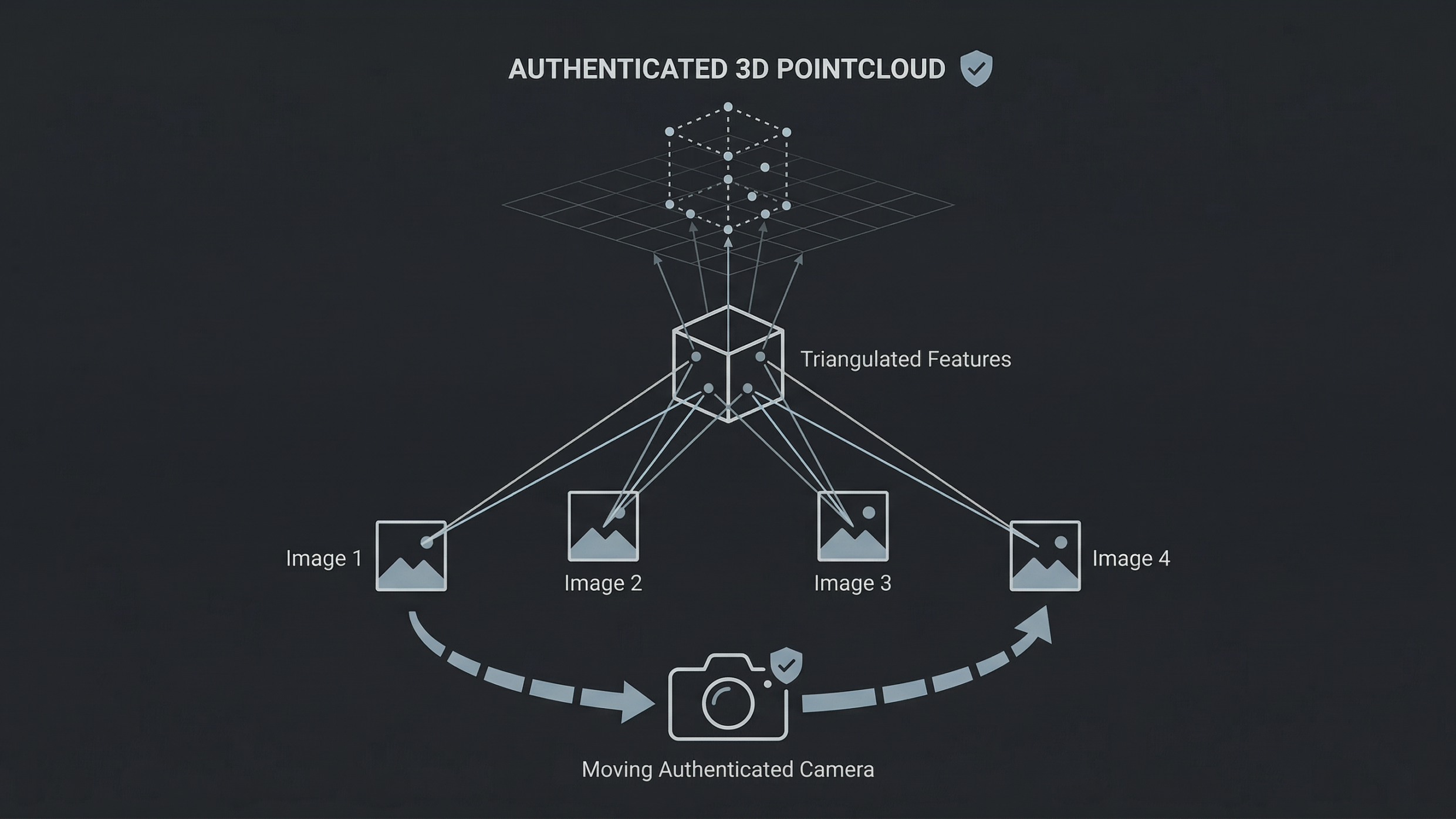
A radience field and its underlying pointcloud
Previous advances in image manipulation, such as darkroom techniques, Photoshop, CGI special effects were detectable by experts, and producing convincing fraudulent images required significant skill, effort, and time. Well-made forgeries were expensive, rare, and could still be debunked by people who knew what to look for.
Today’s tools are different in four ways:
Accessibility. Creating photorealistic synthetic content no longer requires expertise or significant resources. Consumer apps and cloud services can do it for pennies. Students with no graphics background are creating immersive 3D environments in minutes.
Quality. The outputs are becoming indistinguishable from reality. Not “good enough to fool casual observers,” but actually indistinguishable from the real thing.
Volume. Creating a thousand fakes is just as easy as creating one. A single bad actor can overwhelm society’s ability to detect and debunk in a timely manner, defeating fact checking by sheer volume. Once a fraud has spread on social media, the damage is done.
Blending. This is the shift that doesn’t get enough attention, and it’s the one that concerns us most. The most challenging content isn’t purely synthetic — it’s hybrid. Real captures algorithmically extended. Authentic photographs turned into explorable 3D scenes. Genuine footage enhanced with generated elements. Where does documentation end and fabrication begin? At what point does an immersive 3D experience based upon a single photo cease to inform and begin to mislead?
In our own experiments at Spatial Lab, we’ve encountered this boundary directly. When we used World Lab’s Marble to convert a 1940s photograph of a scene of the forced detention of Japanese Americans into a 3D environment, the result was stunning — and deeply ambiguous. The original photograph anchored the scene, but the model filled in buildings and landscape, and inferred objects that were never captured. To a viewer navigating the space, every surface looked equally real. Nothing in the experience distinguished what was documented from what was hallucinated.
This isn’t a failure of the technology. It’s working as designed. But it’s a problem that we currently have no widely adopted means to know whether what we are looking at is real.
The same technologies that threaten trust also offer unprecedented capabilities for understanding. A journalist with Gaussian splatting can show audiences a disaster scene in three dimensions, letting them understand spatial relationships that flat photographs obscure. A historian can transform a single archival image into an explorable environment, bringing the past alive in ways previously impossible. A prosecutor can reconstruct a crime scene from authenticated source material, letting jurors experience spatial context that flat images cannot convey.
These are genuinely valuable uses. They serve truth, not deception — if we can establish that the underlying sources are authentic and the reconstruction process is faithful to the source and transparent.
At Spatial Lab, we believe the post-photographic age can be navigated successfully. But only if we build the infrastructure now. That means:
Cryptographic provenance for source material. Before any reconstruction begins, the input imagery should be authenticated. Where was it captured? When? By whom? This creates a root of trust that can flow through the entire pipeline. Distributed ledgers are well-suited for this — they produce easily verifiable, public, unalterable, and permanent records.
Transparency about reconstruction processes. Audiences need to know what tools were used, what choices were made, and where algorithmic interpolation occurred. Not buried in technical metadata — surfaced in the experience itself. We’re prototyping what we call a “nutrition label” for synthetic media: a standardized way to communicate the ingredients of a spatial experience.
A visual language for uncertainty. In traditional media, the boundary between the known and the unknown is implicit. Photographs have borders where the image ends. Videos have a beginning and end. We understand that beyond the frame, there is a world we have no information about. AI-generated content is different. The source image is a jumping-off point from which the technology can endlessly generate beyond the original frame. But to the viewer, both the ground-truth image and the AI-hallucinated extension appear equally real.
We’re researching ways to show audiences, in real time, the boundary between captured reality and generated content — UX overlays that apply color, blur, or other visual cues to signal uncertainty while maintaining both immersion and honesty. The tools have to be built first.
Spatial Lab exists to do this research in public — to share experiments, invite debate, and prototype solutions. We’re an academic initiative at the intersection of Stanford and USC, not a company selling products. Our goal is to develop frameworks that anyone can implement.
If you’re working on similar problems, we want to talk. If you think we’re wrong about something, we want to hear why. If you’re from an industry that will be affected by these changes, we want to understand your concerns.
The post-photographic age arrived faster than anyone expected. The frameworks for trust can still be built. This is an invitation to help build them.
Spatial Lab is a publication of Starling Lab, a joint initiative of Stanford University and USC focused on data integrity. We cover spatial intelligence technologies for journalism, law, and historical documentation.