

Authenticated Change Tracking

We integrate cryptographic provenance into the newsroom’s editorial lifecycle, ensuring that every modification – from photo edits to caption and metadata updates – is recorded in a verifiable, append-only log. By retrofitting existing Content Management Systems (CMS) with an authentication layer, newsrooms can provide an unalterable “audit trail” of their reporting process.
This shifts the trust model from static files to a dynamic, tamper-evident lineage, restoring transparency to the news-gathering and publishing workflow.
YEAR
2022-25
PARTNERS
Reuters
Hypha Coop
Fotoware
LINKS
– Case study: End-to-end authentication at Reuters from Canon cameras
– On displaying this metadata with Four Corners and Wordpress
The Problem
Modern newsroom Content Management Systems (CMS) are designed for efficiency, and can be improved to provide more evidentiary rigor. While they track changes internally, these records are stored in private, centralized databases that are vulnerable to tampering and opaque to the public. As stories evolve from raw field captures to published articles, critical metadata (like original capture time or source identity) is often lost or stripped during the editing process.
This creates a “black box” that prevents audiences from verifying the reporting’s journey and leaves journalists unable to defend their work against claims of post-capture manipulation.
The Solution
Starling is working to understand the existing tools that newsrooms use to ingest information and to write and edit their stories, and we are working to integrate the ability to better track and authenticate changelogs of images, text, and other documents. Our goal is to improve the ability of newsrooms to work on authenticated information, and add authentication to changes they make, within their existing content management systems.
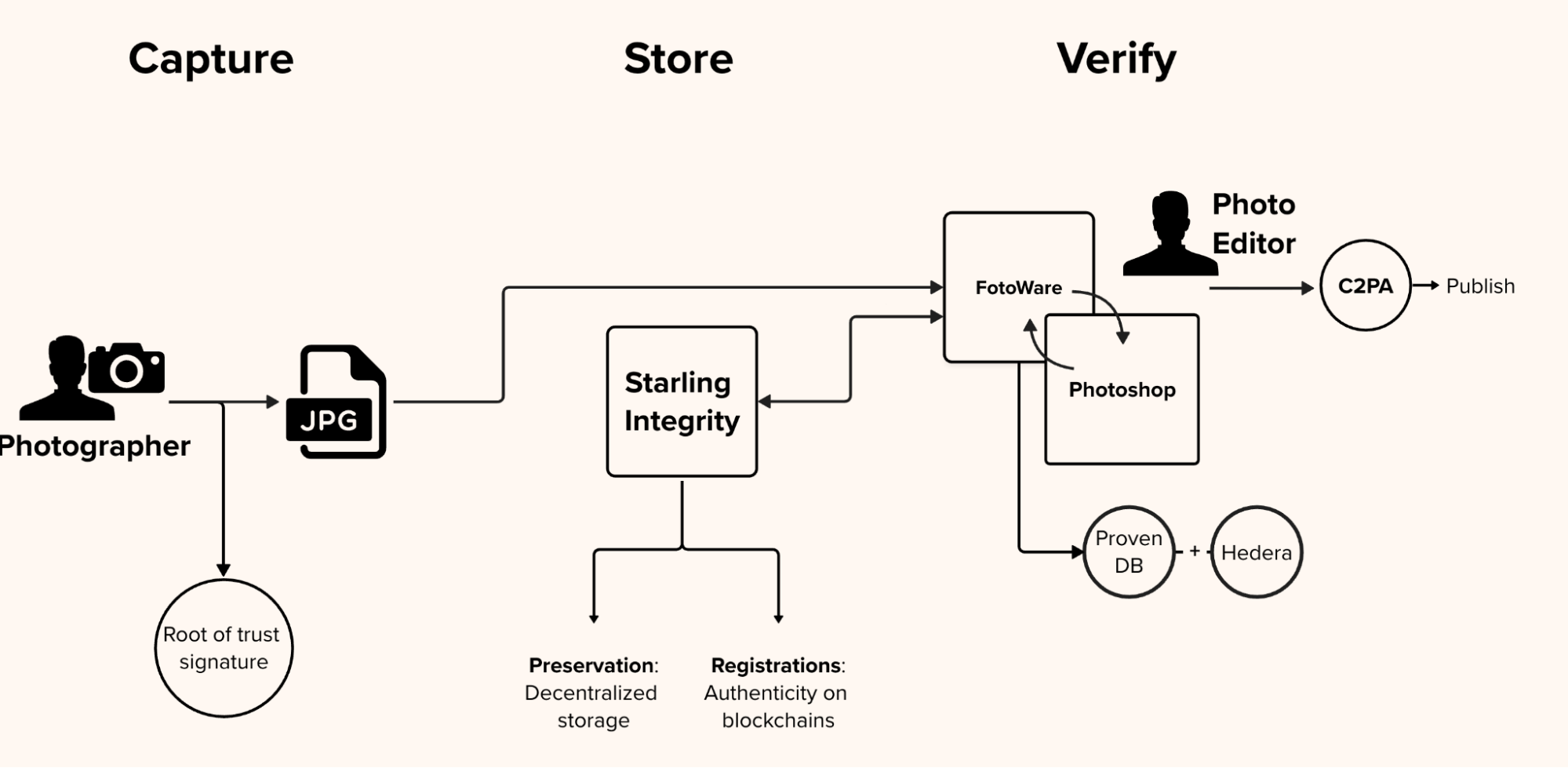
In the diagram above, CMS and Photoshop work in tandem so that the photographs’ edit history in Photoshop be reflected inside the CMS. In our milestone collaboration with Canon Camera and Reuters News, we designed a system that creates an immutable audit trail that works invisibly alongside standard newsroom tools. As the image is transmitted to the publisher’s asset management system and undergoes permissible edits by photo editors—such as cropping, color correction, or captioning—an automated background process tracks the file. Every single modification is recorded in a private, verifiable database that is anchored to a public distributed ledger, creating a mathematically provable edit log.
We are also prototyping how this information can be displayed to audiences, and looking for a greater understanding of what these metadata markers might mean to readers and the trust they place in stories and media. This final step focuses on empowering the end consumer: the reader. The prototype packages the initial hardware signature, the original metadata, and the complete, cryptographically secure edit history into a standardized, open-source manifest. This manifest is embedded directly into the final published image, allowing anyone—from researchers to everyday readers—to inspect the file and independently verify its authentic journey from the frontlines to their screen.